EVs will dominate new car sales within 5-6 years

What does that mean for Tesla and others?

EVs include both BEVs (Battery Electric Vehicles) and PHEVs (Plug-In Hybrid Electric Vehicles). We’ll start with a top-down view and then go into substantial detail regarding Tesla followed by some overall discussion of Rivian and Lucid.

California is taking the lead in banning sales of new gas-powered cars by 2035.

In August 2021, President Biden issued an Executive Order setting a target that by 2030, 50% of all new vehicles sold in the US will be net zero emitters of greenhouse gasses. He has recently added a goal of 60% by 2032. California has drawn a line in the sand regarding legislating the end of gas-powered vehicles. A measure approved by the California Air Resources Board requires all new light vehicles (passenger cars, SUVs and pick-up trucks) sold in the state in 2035 or later to generate zero emissions. It is a little unclear whether this will allow PHEVs to be sold, as they do generate emissions, but my reading suggests that PHEV models that can be charged at a charging station are probably not currently part of the ban. I expect this to change and believe PHEVs will be banned as well or fall to minimum sales once the conditions for BEVs described below are met. Six other states have already followed California’s lead: Maryland, Massachusetts, New Jersey, New York, Oregon, and Washington. Numerous other states are in the process of considering moving in the same or an even more aggressive direction.

I believe that most of the country and the rest of the world will follow in this direction (unless lobbying efforts slow progress) as the following issues are already or likely to be met by 2030:

  1. BEVs must offer enough driving range to make buyers comfortable;
  2. BEVs with the right characteristics need to become more affordable;
  3. There must be close to the same access to charging stations as gas cars have to gas stations.

Driving Range on dozens of BEVs will likely exceed 500 miles by 2030.

For perspective consider that (according to Electrek) in 2012 there were only 9 EVs available, 8 of which were Hybrids that, on average, could only drive about 70 miles on the battery. The 9th was the Tesla Model S which had a range of 265 miles but cost about $90,000. As late as 2016, there was still only one pure BEV with a driving range of over 300 miles, the Tesla Model S. By 2021, this number had expanded to 5, 3 of which were Tesla models. As of August 2023, there are 14 models with that range including 4 from Tesla, 2 from Rivian and one from Lucid. Lucid has the longest range, 520 miles, but the two Rivians and the Tesla Model S Long Range all are over 400 miles. The list includes 2 models from Ford, two from BMW, plus one each from Mercedes, Kia and Hyundai. What this suggests is that further increases in driving range are not only possible but extremely likely (in fact preliminary reports indicate the next version of the Tesla Model 3 due in 2024 will move to over 400 miles of driving range). I believe that in 7 years, or even sooner, there will be numerous models that have a range of over 500 miles, including all Tesla models, all Rivians and all Lucids. This is a technology issue and as we’ve seen with computers and phones, technology delivers better performance every year.

Affordability is already here…sort of!

The standard Model 3 is listed on Tesla’s website as having a manufacturers suggested retail price of $32,740 after the federal EV tax credit. But California also provides a state tax credit of $7500. After that credit the price drops to $25,240, $1,000 less than a gas-powered Toyota Camry. That doesn’t even consider the lower cost of service and fuel, or the higher resale value of the Tesla. This has led to the Model 3 replacing the Camry as the best-selling car in California, This depends on tax credits so we’re not quite at parity yet on affordability but given the trend we should be in several years.

Charging availability is increasing rapidly.

According to the Department of Energy, the number of charging stations in the US increased from 5,070 in 2011 to 143,711 at the end of 2022. This represents a compound annual growth rate of about 35.5%. The stations have also improved in their speed to charge. It is also easy to install a power line at home to be able to charge the vehicle every night, eliminating the need to use a charging station other than for long trips. Gas powered cars do not offer this convenience. For example, my wife and I recently went from our home in Atherton to Napa for a weekend, a distance of about 90 miles each way. In total, including visiting wineries and restaurants, we drove 340 miles. We never charged the car during the trip as her Tesla’s range is over 400 miles. There are currently over 145,000 gas stations in the US. The number of locations with charging stations now exceeds 54,000. At the historic  growth rate of over 35% this would mean that the number of charging locations could exceed the number of gas stations by the end of 2026. It is also likely that the number of gas stations could decline as the install base of gas-powered vehicles declines.

Sales of BEVs have reached an inflection point.

In 2022 worldwide sales of light vehicles (passenger cars, SUVs and pickup trucks) EVs reached over 10.5 million units, up 55% year/year. This occurred despite the sales of all light vehicles declining slightly versus 2021.

To understand where this is going, we initially need to produce a forecast for total light vehicle unit sales (which, for simplicity we’ll refer to as “cars”) in 2030. I have assumed that by 2026 global unit sales would return to 2018 levels which was 93.7 million according to IHS Markit. I then assumed the volume would grow by 2% per year through 2030. Some would argue that given population growth, matching 2018 volumes 3 years from now is too conservative. Others will say we will not get back to that level. I believe this to be a middle of the road assumption.

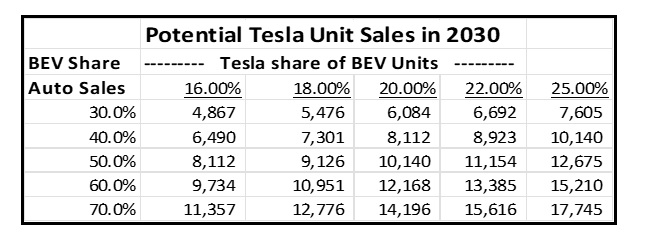
The second question is what share will BEVs be of total auto sales? In the table below I show a range that varies from 30% to 70% (BEVs are over 10% in 2023). If we apply the Biden 50% minimum goal for the US to worldwide sales, then the 2030 number would be 50% of 101.4 million units or 50.7 million units. This would mean an 8-year compound growth rate of 26.6% for unit sales of BEVs (it grew about 60% in 2022). Obviously, this is not an exact science!
I expect Tesla unit sales to be about 8X 2022 levels in 2030.

In 2022 Tesla sold over 1.3 million BEV autos which was 17.1% of the BEV market. That is far from the full story as they did not participate in several large categories of vehicles: pickup trucks, low-cost autos, and sports cars. Their share was over 30% in the categories they did participate in. I believe that by 2030 Tesla will have added all three of these categories to its lineup. If we take the middle row and column of the above chart: BEVs have 50% market share and Tesla sells 20% of BEVs (which is 1/3 share lower than they currently have in categories in which they participate). That would mean Tesla will sell 10.14 million vehicles in 2030. If they did, the company would have an 8-year CAGR of 29%. This is well below the 50% growth they are tracking towards this year but of course the law of large numbers predicts a decline in high growth rates.  

Tesla Stock did not reflect strong expectations in 2022.

Despite revenue growth of over 50%, Tesla was one of the worst stocks in 2022. Partly this was due to fears that Elon’s acquisition of Twitter would be a distraction, partly it was due to the backlog shrinking and partly it was due to Elon liquidating a number of shares to finance the Twitter acquisition. In H1 2023 Tesla was one of the best stocks in the market (appreciating over 110%) as the backlog began to (slightly) expand again, Elon stopped selling shares (and promised to hold his position for the rest of 2023) and the Twitter acquisition became less of an issue to investors. It should be noted that as of September 10, Tesla shares have slipped by about 5% from the June 30 value over new fears that Tesla price cuts were hurting earnings. It was obvious to us that the price cuts were to leverage superior manufacturing cost and drive increased volume and this has in fact occurred, but Tesla will remain a volatile stock which is why premiums on Tesla calls are quite high.

Unlike some, we believe Tesla was smart to raise prices substantially in 2021 and 2022 while they could not meet demand. Then we believe they were smart to lower prices once their manufacturing capacity expanded, and backlog shrunk to a more normal level. Lowering prices places tremendous stress on the competition as Tesla has significant margin advantages over its competitors. Its net margins are still strong at lower prices, but many competitors don’t have the room to maintain margins at lower prices. Additionally, lowering prices on Tesla mass market vehicles meant that many Model Ys and Model 3s qualified for the US $7500 tax credit for electric vehicles that started on January 1, 2023. Nonetheless, the level of price decreases is worth monitoring as it does lower Tesla gross margins.

We expect Tesla unit sales to increase 45% to 55% in 2023.

Despite rising slightly in H1, the decrease in the Tesla backlog remains a concern to investors. At year end it was at about 44 days of production (or roughly ½ of units sold in Q4). While there are many elements to consider, some investors have a concern that it will be difficult for Tesla to achieve or exceed its target of 40% vehicle sales unit growth in 2023. Given already announced sales in Q2, Tesla unit sales were up 60% in H1. However, this includes a very weak comp in Q2 2022 due to China being closed for part of Q2 last year. Still if the company merely replicates Q2 sales in Q3 and Q4 for existing vehicles and adds sales of the Cybertruck to this total, 2023 growth would exceed 45%. There are several factors that indicate they are likely to continue to increase sales sequentially:

  1. In Q2 Tesla actually shipped more cars than it produced despite increasing production, while backlog remained relatively stable. 
  2. Historically Tesla has seen demand increase sequentially in virtually every quarter. If we assume a 7% increase going forward, then units will be up over 50% year over year in 2023 without any Cybertruck sales.
  3. The Tesla CyberTruck has a waitlist that exceeds 1.5 million vehicles. On August 16 Electrek reported that “truckloads” of Cybertrucks were spotted being delivered. These would not be for consumers but rather for final testing. Tesla has indicated that it will be hosting a launch date for the vehicle and speculation is that it will be quite soon. They then will begin building towards volume production starting in Q4. If existing product sales fall short of the 7% sequential increase in Q3 and Q4, sales of the CyberTruck could make up for the difference as these sales will be incremental to the current run rate for existing vehicles.
  4. The company now has the manufacturing capacity to increase volumes – the question will be parts supply and whether demand will be strong if the economy goes into a recession.

Despite a reduction in its backlog in 2022, demand for its vehicles continues to increase. As you hear of new competition in the electric vehicle market keep in mind that Tesla share of the US market for ALL cars is still only about 3% and in China and Europe it remains under 2%. As a comparison Toyota worldwide market share is over 13% and VW is not far behind. We estimate that Tesla’s share of BEVs in the categories it plays in is over 30%. Once it launches the Cybertruck it will increase its available market (TAM) substantially. But it will still need to launch a low-priced vehicle (in the $25,000 – $30,000 range) and a sports car (which it is working on) over the next 3-5 years to address the total market. As the world transitions to electric vehicles, we expect Tesla’s share of all auto sales to rise substantially even as it declines in dominance of the electric vehicle market. When the CyberTruck begins shipping, Tesla total backlog is likely to increase to over 1.6 million vehicles. And the CyberTruck current backlog isn’t expected to be fulfilled until late 2027! 

Tesla Margins

Tesla gross margins declined in Q1, as price decreases had an impact. In Q2 Tesla made further price decreases but this was partially offset by improved efficiency in newly launched factories in Berlin and Texas. While lower vehicle prices in 2023 and increasing cost of parts will place some pressure on gross margins, we still believe they will continue to remain by far the highest of any auto manufacturer:

  • Tesla, like Apple did for phones, is increasing the high margin software and subscription components of sales;
  • Add-on sales are likely to offset a portion of price decreases;
  • As its new factories ramp they will increase their efficiency; and
  • Tesla will have lower shipping cost to European buyers as the new Berlin factory reaches volume production.
  • A decline in gross margins can be at least partly offset by SG&A declining as a percentage of sales as revenue growth is likely to be higher than any increase in SG&A.

Revenue in the Semi category could surpass $10 billion in a few years.

To date the Tesla Semi has been produced in very small volumes and limited production capacity will mean deliveries will remain low during the next few quarters. We believe the ramping of Semi production will begin in late 2024 as the company only has a small number in customers’ hands today (essentially for test purposes). However, given its superior cost per mile the Semi is likely to become a major factor in the industry. Despite its price starting at $150,000, its cost per mile appears lower than any competitive products. Given potential of up to $40,000 in US government incentives the competitive advantage over diesels will be even greater. The company is expecting to increase production to about 50,000 per year by some time in 2025 (which would represent potential incremental high margin annual sales in the $8-$10 billion range). While this is ambitious, the demand could exceed that as it represents a single digit percent of the worldwide market for a product that should have the lowest cost/mile of any in the semi category.

Tesla Expects to launch a new Roadster in 2024

The new version of the roadster is being developed but it’s unclear when it will be ready for production as the target date has slipped multiple times. Right now, Tesla expects the launch to be in 2024. Once it launches, it will become another source of incremental demand at high margins. The early claims are that it will have a driving range of over 600 miles (at reasonable speeds), a top speed of 250 miles/hour, go zero to 60 in 1.9 seconds and cost about $200,000 for the standard model. This would make it faster than a McLaren.

The Bottom Line: Tesla should continue to have accelerated revenue growth in Autos.

This all points to solid revenue growth continuing (but at a lower level than unit sales growth in 2023), strong GMs in 2023 and beyond, and earnings escalation likely faster than gross margin dollar growth. While the company has reduced pricing, the ability to sell greater dollars in software should help maintain strong AOV and gross margins.

Tesla is not a one trick pony – it has several other potentially large revenue streams.

There are numerous other revenue sources for Tesla, especially on the energy side given its strong solar offerings and best-in-class power walls. Tesla also is a leader in automated driving and should that reach commercialization for “driverless taxis/driver services” the company is well positioned to add a substantial revenue stream. The discussion above regarding charging stations did not include the fact that Tesla is the runaway leader in this category (it just reached 50,000 units deployed) and its technology is probably going to become the standard. So, while I believe the vast majority of charging will take place in the home, Tesla will add another revenue stream from their infrastructure. Recently GM, Ford and Rivian have all decided to move to the Tesla charging technology.

Finally, there is some possibility that Tesla’s Optima Robot project will, at some point in the future, lead to launching smart robots that can perform numerous tasks. The company has taken its AI developed for autos as well as the variety of sensors integrated into a vehicle and transformed them to apply to robotics. At their AI day 11 months ago, they were able to demonstrate a humanoid alpha version that could walk with knowledge of what was in front of it and around it. The robot could also pick up objects and perform other simple tasks. We expect a significant leap forward at this year’s AI day scheduled for September 30. Elon, who tends towards optimistic thinking, has stated that he believes revenue from the Optima could exceed Auto revenue at some point in time!

A few comments on Rivian.

Rivian has gotten quite a bit of press regarding its opportunity to be one of the leaders in BEV pickup trucks and SUVs. The Rivian R1T electric pickup truck has recently earned the J.D. Power award for the most satisfying experience among BEVs (Tesla was second). The study, released in February, benchmarked EV owner satisfaction with critical attributes that affect the EV ownership experience. Reviewing 2022 and 2023 model year battery electric and plug-in hybrid vehicles, EV owners found R1T to be best among premium battery electric vehicles for driving enjoyment, vehicle quality and reliability, service experience, interior/exterior styling, cost of ownership, ease of charging at home and accuracy of stated battery range.

Cars.com reviews gave Rivian a 5.0 out of 5.0 rating with 100% of customers saying they would recommend it. A second review site, Edmunds, with a minimal number of reviews, was less favorable as most reviewers rated it highly, but several reviewers liked the vehicle but were dissatisfied with the quality of service. We believe the JD Power survey to be the most reliable. The strong customer experience positions the company for accelerated top line growth. In Q2 revenue was up over 200% year/year and unit sales increased 59% sequentially. Rivian also increased their guidance of how many vehicles they will ship this year to 52,000. Despite the Ford F150 pickup being touted as the clear leader in the category, CNBC reported that Rivian actually sold more electric pickup trucks in the US in H1 than anyone else. In a recent survey by Car Guru, 43% of potential truck buyers said they favored buying an electric vehicle.

Rivian also has an order to build 100,000 electric vans for Amazon. Amazon says it has taken delivery of 5,000 already and I have recently seen a few on the road in the SF Bay Area. I asked the driver of one what she thought of the product. Her reply was that it was quite an improvement versus her prior van. In searching for other products that compete there appear to be numerous others manufacturing this type of product. It’s hard to tell if the Rivian van has an overall advantage but it does seem to have the longest range of any that I found. This appears to be a very large opportunity for Rivian as the price of its vans start at $60,000 so the existing Amazon order is worth at least $6 billion (5.4X Q2 Rivian revenue) and Amazon could decide to expand the order. The fact that its competitors does not include Tesla puts Rivian in a strong position.

Given the quality of its vehicles, Rivian is well positioned to scale if they can fix their economics. In Q2 gross margins on its vehicles improved by $35,000/vehicle over a year earlier but still came in at a loss of $412 million. If the company can move to profitability (a target it expects to reach in late 2024) without compromising vehicle quality, it could be a very strong performing stock. The risk that they don’t get there before running out of cash has kept the stock value low.

Lucid appears to be struggling.

Lucid produces a very high-end electric sedan that directly competes with the Tesla Model S. The Lucid Air is more luxurious and has a longer driving range than the Tesla but also costs more. The product gets great reviews from magazines like Car & Driver who said: “ As luxury electric sedans go, the Air is a home run, delivering a posh overall experience with an unbeatable driving range.” Given such accolades many thought the Air would be a worthy competitor to Tesla. However, consumers have not embraced the product as their reviews are just OK. Cars.com reviewers gave it an average rating of 3.3 out of 5 and only 46% of those reviewed said they would recommend it. As a comparison the Tesla Model S received a 4.0 average rating and 80% of reviewers said they would recommend the car. Admittedly, the number of reviews was small, but this is still an issue for Lucid.

Lucid appears to have lost momentum in the marketplace as Q2 sales of 1,404 units were flat compared to Q1 and fell well short of Wall Street expectations of 2,000 units. This also put into question whether Lucid was successfully converting the 28,000 reservations it had previously disclosed.

On the positive side, Lucid is extremely well funded and struck two interesting deals in the quarter:

  1. To supply Aston Martin with power trains, battery systems and related technology in a deal worth $232 million.
  2. To begin sending cars to Saudi Arabia which may help relieve the company’s inventory build up as it produced over 1,700 more vehicles than it sold in H1.

Both deals must be taken with a grain of salt as the Saudi Arabia Public Investment Fund is a major backer of both Lucid and Aston Martin.

Lucid will be launching new lower priced vehicles going forward so it still remains a company with potential given its ample capital, quality technology and well-designed vehicle. But, unlike Rivian which has carved out a niche where Tesla is not a direct competitor (now or in the near future), Lucid will have to find a way to be more successful versus this dynamo.

The Warriors Revisited

It’s been a while since I posted, so I’m going to try to get 2 new ones out over the next 30 days. This one will be a return to my favorite sports team: The Warriors (or simply “Dubs”). It addresses several topics that have been heavily discussed in the media:

  • Should The Dubs trade Kuminga?
  • Have the The Dubs have abandoned their “2-track timeline (2TT)”?
  • Why did The Dubs trade Poole and others for Chris Paul?
  • What are the chances that The Dubs will win the title this upcoming season?

Should The Dubs trade Kuminga: Why Suggested Kuminga Trades Don’t Make Sense

A number of suggested trades that include Kuminga (and often Chris Paul) have been suggested in the media. We regard all the ones we’ve seen as substantially sub-optimal. First, any suggested trade that includes Paul would likely prevent the team from getting to their financial target (of under the luxury tax second apron) in the 24-25 season. If they don’t get under that apron, they will be heavily restricted in signing free agents and in what types of trades they can do.

Kuminga has progressed substantially. He was especially good in the final part of last season and should be better this year. He appears on the road to being a star in the NBA. Most of the suggested trades were for players who have been in the league a lot longer, are on larger contracts that were not about to expire (defeating the Dubs ability to get under the second apron penalty level in 2024-25), or for players that I believe Kuminga is already as good as or better then. Given that he is still early in his career we believe that he is likely to significantly improve from here. The fact that Kerr barely played him in last year’s playoffs is the reason trades are being suggested. The “experts” who are suggesting them are ignoring how good he was defensively and offensively in the second half of last season.  I think Kerr not using him in the playoffs was an error but motivated by the fact he is still very young, and Kerr wanted to add motivation for him to improve his rebounding.

All statistics from the Basketball Reference Guide

There are so many suggestions to trade Kuminga that it’s impossible to review them all. Instead, I’ll provide 2 typical examples to illustrate why they don’t make sense for the Warriors. One example is a proposed trade for Anunoby. Since Anunoby will make $12M more than Kuminga next season, the Warriors would also need to give up Moody and Payton (to match salaries). If they do that the cap rules would require signing minimum salary replacements who likely would be of lower quality than Moody and Payton, a major negative of such a trade. But even comparing Kuminga to Anunoby straight up is interesting. Since Anunoby played almost 36 minutes per game last year and Kuminga less than 21, the fairest comparison is to use stats per 36 minutes. Assuming they played the same amount of time each game, Kuminga would have averaged more points, rebounds and assists than Anunoby despite being 6 years younger and only in his second season (whereas Anunoby was in his 6th ). Since most young players improve dramatically between their 2nd and 6th seasons, Kuminga likely has significantly more upside than Anunoby. Kuminga also had a higher effective field goal average, trailed Anunoby slightly in 3-point % for the season but shot a much higher 49% from 3 in his last 19 games (and increased his rebounds and overall shooting as well). The one area where Anunoby is currently better is on defense (he was named to the NBA’s second team All-Defensive Team last season). But Kuminga, while not yet at an All-NBA level, became an outstanding defensive player in the latter part of last season. The statistics show that Kuminga is already a more efficient scorer, a better rebounder and better passer. Since Anunoby is ahead as a defensive player, they appear pretty equal already with Kuminga likely to surpass Anunoby this season or next.

A second example is a proposed trade for Thybulle. The suggestion includes the Warriors also giving up Cory Joseph and Tryce Jackson-Davis plus the teams swapping first round picks in 2029. The swap is so far out that it is hard to tell who would benefit so I think of it as the Warriors giving up Kuminga plus some extra for Thybulle. While Thybulle is a very strong defensive presence, that is a minor plus since Kuminga is already very strong defensively and should improve. On offense there is no comparison. Kuminga scores over 90% more points per 36 minutes, garners 30% more rebounds, generates over 75% more assists and maintains a higher shooting %. Combine this with a lower salary and how much better Kuminga was in the latter part of last season, this suggestion seems ludicrous as are most others that have been made by so-called “experts”.

I have used these examples as they typify how under-valued Kuminga is in speculated trades. That does not mean the Warriors would never trade him but at this point in time it seems to me to be extremely unlikely as he represents a high-quality player with unlimited potential at a low salary cost for the next 2 years. I view Moody as another potentially high-quality player (at a low cost) with strong upside but probably not quite as much upside potential as Kuminga. Unlike the beginning of last season, they both seem ready to emerge and become important cogs in a possible title run this year.

Have the The Dubs have abandoned their “2-track timeline (2TT)”: Two Track Timeline Very Much Alive!

Trading both Wiseman and Poole as well as several of last year’s rookie class has stirred a hornet’s nest of comments that the 2TT has been abandoned. We disagree and believe that it is still in play but modified to a more realistic timing for Track 2. Instead of thinking 8-10 years out, why not have:

Track 1 be the next 3 years (remainder of Curry contract).

Track 2 be the subsequent 3 years.

Let’s face it, even 6 years is a lifetime for the NBA as every one of the players below will have the opportunity to be a free agent within that period. And after 6 years all of them will have a second opportunity for free agency. So, trying to think beyond that is unrealistic as too many things can happen. With that in mind, here are the key players for track 2. Bear in mind this assumes everyone mentioned below will sign at least one new contract with the Warriors. Curry, Thompson, and Green will be 38, 36 and 36, respectively, at the start of the 2026-27 season. They are not included below but, of course, it’s somewhat likely that one or more of those 3 will still be a solid player that contributes to Track 2.

Track 2 – Potential Players from Current Roster (ages at beginning of 2026-27 season)

  1. Andrew Wiggins (31)
  2. Kevin Looney (30)
  3. Gary Payton II (33)
  4. Jonathan Kuminga (24)
  5. Moses Moody (24)
  6. Lester Quinones (25)
  7. Brandin Podziemski (23)
  8. Trayce Jackson-Davis (26)
  9. Gui Santos (24)
  10. Subsequent draft picks ?

Including Wiggins, Looney and Payton is quite realistic as they will all be in their peak years. In addition, the Dubs currently have 6 players that would be between 23 and 26 when we reach Track 2. Santos and Quinones are included because the high quality of their play in the G League indicates that they are currently better than last year’s rookies that were traded. But while both are under contract, neither is currently on the roster. Much has been made of the trades of Wiseman and Poole, but I believe that neither trade signifies abandoning the future as long as the Dubs keep Kuminga and Moody on the team. Wiseman was traded because he was a disappointment. Poole became a liability after signing a very rich 4-year contract a year ago (that would begin in the 2023-24 season) and then regressed significantly during last season.

In addition to improving the Track 1 team by trading Poole for Chris Paul (who is currently better), the Dubs also put themselves in a stronger position to acquire additional talent after the 2023-2024 season as they can get under the salary cap second apron in the 2024-25 season since Paul’s contract of $30M is not guaranteed for that year. The benefit of this is quite obvious when we consider the fact that the team might have kept DiVincenzo or signed a high-quality free agent if they had the flexibility that being under the second apron provides. Additionally, assuming several of the 6 players emerge as stars, the timetable for when they would need to be paid has a better spread than before since 4 of the 6 are rookies this year or next. The other 2, Moody and Kuminga, won’t be eligible for a contract extension until the 25-26 season giving the Warriors the opportunity for a cap reset in 24-25. When this is combined with the jump in cap expected in 2025 (due to a new TV contract) the Dubs can remain under the second apron in the 2025-26 season even if they need to substantially increase what they pay the two of them.

We are not suggesting that all 9 of these players will be on the team for Track 2 but rather that there is a strong potential available young core. While I firmly believe Kuminga and Moody can be stars this is not a given. If they fail to emerge then Track 2 may require the signing of a star free agent.

Why did The Dubs trade Poole and others for Chris Paul? We believe the Chris Paul for Poole trade was a positive for the Warriors this season.

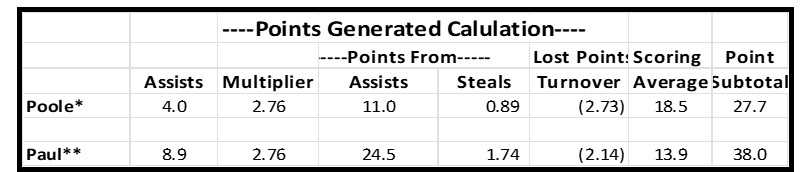
One way to compare the offensive value of each player is to compare Poole (in the 21-22 championship season) to Chris Paul last year using “net points generated” shown in the table below. It adds together the point value of assists and steals to the player’s scoring average and then subtracts the lost opportunity from turnovers to establish one overall number. While this will certainly be far from exact, using Chris Paul’s averages from last season in the comparison seems the best approximation of what he might do this season. We used the numbers from Poole in the championship season so we have a basis of comparison of the current team to the one that year, but it should be noted that while Poole scored more last season than the year before, it was due to taking more shots since his field goal efficiency declined (to below the league average) and he also had less rebounds and more turnovers last year.

In this past season, 38.5% of Dubs-made field goals were 3- point shots. That means an average field goal was worth 2.385 points. They also made .371 foul shots for every field goal made. Assuming passes generate .371 made foul shots for every assist that would mean an assist would generate an average total of 2.385 + .371 (2.756)  points for the Warriors. The foul shots would come from passes where the recipient made the shot and was fouled plus those where the recipient missed the shot but was fouled. We believe the passer helped generate the foul shots in both cases and that there is a strong correlation between assists and passes that resulted in a missed assist because the recipient was fouled. We believe the points generated per assist are more valuable than unassisted field goals as it seems logical that an assist, on average would lead to a higher shooting percentage than unassisted shots and there would be more frequent times that no assist was recorded because the player was fouled.

*Poole stats for the 21-22 championship season  **Paul stats for 22-23 season.  Base Data from Basketball Reference guide   

In this past season the Warriors averaged 118.94 points per game and had about 105.6 possessions per game. This means they score 1.126 points per possession. If we assume a steal generates an average possession, then each steal would be worth 1.126 extra points to a team (we think it actually generates more than 1.126 points as many steals lead to uncontested shots – a higher number favors Paul). Using this value in points per steal provides the points from steals in the above table. Finally, every turnover takes away a possession from your team. So, using the same logic the above table subtracts the point value of those lost possessions. Summing the numbers shows that Chris Paul generated over 10 more points per game last year than Jordan Poole did in the championship year.

Paul shot a higher percentage from 3-point range and is a better defender than Poole. The main advantage Poole has over him is his explosive ability to get by defenders resulting in a higher 2-point field goal percentage. This analysis shows that Paul generates over 10 more points of offense than Poole per game. Even if that number turns out to be off by half when he joins the Warriors, the extra 5 points should mean a lot more wins! To me, it seems clear that the Dubs will be a better team with Paul this coming season. The risk to the trade is that Poole has a lot of talent and if he improves his defense and becomes more disciplined on offense, he could become a star in the future whereas Chris Paul is at the tail end of his career.

Can The Warriors make a Title run?

Let me start by saying this Warriors team appears better than the 21-22 title team. Comparing:

  1. Klay was finding his legs when he returned mid-season in 21-22 from a 2 ½ year absence.
  2. Kuminga and Moody were rookies, and they are both significantly better now.
  3. Gary Payton II was just emerging, and the team had to learn how to maximize his value.
  4. Kevin Looney is better now than he was in the Championship season and Kerr also is better at how to use him.
  5. Wiggins missed a major part of last season but is reaching the peak years of his career. He should be as good or better than the 21-22 season on both offense and defense.
  6. In the championship year, Jordan Poole was excellent on offense but was quite weak on defense and had a lot of turnovers.
  7. This season Chris Paul will replace Poole and will likely generate more points of offense due to his assists, steals, rebounds, and fewer turnovers. Despite his no longer being at his peak on defense he still should provide better defense than Poole.
  8. A key player in 21-22 was Otto Porter Jr. I believe Saric is as good.
  9. While other role players matter, they will get little court time in the playoffs, so if Curry and Green are as good this coming season as they were in the championship year then the Warriors will be much better. Last season Curry and Green were both better than the 2021-22 season. Curry scored more, had a higher 2-point and 3-point shooting percent, garnered more rebounds, and had roughly the same average number of assists per game. He also was a better defensive player than the year earlier. Last year, Green improved his scoring, had higher 2-point and 3-point shooting percentages and almost the same rebounds and assists per game while finishing 4th in the voting for Defensive player of the year.

Putting the above together leads me to believe the Warriors are better equipped to win the championship than in the 21-22 season. However, the competition is stronger this coming season than in the 21-22 season.

In the West:

  • Denver was missing Jamal Murray in 21-22 but had him back last year when they won.
  • Arizona now has Durant and Beale, 2 great players to go along with Booker and Ayton.
  • The Lakers added Gabe Vincent and Cam Reddish to a solid roster.

In the East:

  • The Celtics added Porzingis but gave up Smart – still probably makes them better.
  • The Bucks added Malik Beasley and Robin Lopez plus kept every one of their core 7 players.

Sacramento is a young team on the rise and could also contend. If the competition had not improved, I’d be picking the Warriors outright to win this year. Even with improved competition, I believe the Warriors can win this year (I didn’t think so last year) but they will need to be healthy come playoffs and playing their best ball.

Soundbytes

Just a quick reminder that I will be posting again within 30 days. The topic will be a deep dive into electric vehicles with mostly an emphasis on Tesla and some thoughts on Rivian and Lucid.

Top Ten List for 2023

2022 was one of the worst years in the past 50 for the stock market in general, and for my stocks in particular. There are multiple ways to look at it. On the one hand I’m mortified that stocks that I selected have declined precipitously not only impacting my personal investment portfolio but also those of you who have acted on my recommendations. On the other hand, I believe this creates a unique opportunity to invest in some great companies at prices I believe are extremely compelling.

What went wrong for my stock picks in 2022? I have always pointed out that I am not amongst the best at forecasting the market as a whole but have been very strong at selecting great companies which over the long term (5 years or more) typically have solid stock appreciation if their operating performance is consistently good. But even great company’s stock performance can be heavily impacted in any given year by market conditions. Two key drivers of negative market conditions in 2022 were the huge spike in inflation coupled by the Fed raising rates to battle it. Inflation peaked at 9.1% in 2022. To put this in perspective, in the 9 years from 2012 to 2020, inflation was between 0.12% and 2.44% with 6 of the years below 2.0%. It began to increase in 2021 (up to 4.7%) but many thought this was temporary due to easing of the pandemic. When the rate kept increasing in the first half of 2022 the Feds began to act aggressively. A primary weapon is increasing the Fed Rate which they did 7 times in 2022 with the total increase of 4.25% being the largest amount in 27 years.

When rates increase the market tends to decline and high growth stocks decline even faster. So, the big question in 2023 is whether the expected additional rate increases projected at just under 1% for the year (which theoretically is built into current share prices) is enough for The Fed. In November, inflation was down to 7.11% and decreased further in December to 6.45%. If inflation continues to ease, The Fed can keep rate hikes in line with or below their stated target and market conditions should improve.

Of course, there is another issue for bears to jump on – the potential for a recession. That is why the December labor report was comforting. Jobs growth remained solid but not overly strong growing at 247,000 for the prior three months. This was substantially lower then where it had been at the end of 2021 (637,000 in Q4). While jobs growth of this amount might lead to wage growth of substance, the growth in December was a fairly normal 0.3%. If this persists, the theory is that inflation will moderate further. Additionally, more and more companies are announcing layoffs, particularly in the Tech sector.

I pointed out above that I am not a great forecaster of economics or of the market as a whole so the above discussion may not mean inflation moderates further, or that Fed Rate hikes stay below a one percent total in 2023, or that we avoid a deep recession – all of which could be further negatives for the market. But given where stocks now sit, I expect strong upside performance from those I recommend below.

I also want to mention that given the deep decline in the market, 2022 was extremely busy for me and the decline in blogs produced has been one of the consequences. I’ll try to be better in 2023! I am going to publish the recap of 2022 picks after the new Top Ten blog is out. Suffice it to say the recap will be of a significant miss for the stocks portion of the forecast, but that means (at least to me) that there is now an opportunity to build a portfolio around great companies at opportune pricing (of course I also thought that a year ago).

Starting in mid-2021 the Tech sector has taken a beating as inflation, potential interest rate spikes, the Russian threat to the Ukraine (followed by an invasion), a Covid jump due to Omicron and supply chain issues all have contributed to fear, especially regarding high multiple stocks. What is interesting is that the company performance of those I like continues to be stellar, but their stocks are not reflecting that.

For 2023, the 6 stocks I’m recommending are Tesla(TSLA), Amazon (AMZN), CrowdStrike (CRWD), Shopify (SHOP), Data Dog (DDOG) and The Trade Desk (TTD). The latter two replace Zoom and DocuSign. While I have removed Zoom and DocuSign from this year’s list, I still expect them to appreciate but their growth rates are substantially below their replacements.

In the introduction to my picks last year, I pointed out that over time share appreciation tends to correlate to revenue growth. This clearly did not occur over in the last 12 months or the last 24 months as illustrated in Table 1.

Note: 2022 for CRWD is actually FY 23 estimated revenue as year end is Jan 31. 2022 revenue uses analyst consensus estimates for Q4 which has on average been lower than actual revenue. Averages are unweighted.

The average revenue gain in 2022 (FY 23 for CRWD) reported by these companies (using analyst estimates for Q4) was nearly 38% while the average stock in the group was down 58%. In 2021 all the stocks except CRWD were up but only Data Dog had higher appreciation than its revenue growth. But in 2022 Data Dog declined significantly despite over 60% revenue growth. If we look at the two-year combined record the average stock in this group had a revenue increase of over 116% with three of the six increasing revenues by over 150%! Yet, on average, share performance for the group was a decline of over 48%. It should also be noted that Amazon’s major profit driver, AWS grew much more quickly than the company as a whole. Another point to highlight is that the strength of the dollar meant that US dollar revenue growth was lower than actual growth on a neutral dollar basis.

While over time I would expect share performance to be highly correlated to revenue growth, clearly that has not been the case for the past 24 months. I look at the revenue multiple as a way of measuring the consistency of valuation. Of course, these multiples should be lower as a company’s growth rate declines but looking at these 6 companies the amount of the decline is well beyond anything usual. Certainly, the pandemic causing wild swings in growth rates is partly responsible in the case of Amazon and Shopify but the other 4 companies have continued to experience fairly usual growth declines for high growth companies and all remain at strong growth levels.

Table 2 shows the change in revenue multiples in 2021 and in 2022 and then shows the 2-year change as well. Over the 2-year period every one of these stocks experienced a multiple decline of at least 60% with three of them declining more than 80%. Even if one assumes that valuations were somewhat inflated at the beginning of 2021 it appears that they all have substantial upside from here especially given that they are all growth companies. Which means if the multiples stabilize at these levels the stocks would appreciate substantially in 2023. If the multiples returned to half of where they were on December 31, 2020, the appreciation would be pretty dramatic.

Notes: 1. CRWD numbers are for fiscal years 2022 and 2023 ending January 31. 2. For Q4 revenue for each company we used Analyst average estimates. 3. All averages are calculated on an unweighted basis.

Given the compression in revenue multiples across the board in tech stocks, the opportunity for investing appears timely to me. Of course, I cannot predict with certainty that the roughly 75% average decline in revenue multiple among these stocks represents the bottom but we never know where the bottom is.

2022 Stock Recommendations

(Note: as has been our method base prices are as of December 31, 2022)

1. Tesla will outperform the market (it closed 2022 at $123.18/share)

Despite revenue growth of over 50%, Tesla was one of the worst stocks in 2022. While Q4 financials have yet to be reported, the company car sales were announced as 405,278 in the quarter up over 31%. For the year, the company shipped over 1.3 million vehicles up 40% over 2021. These volumes are still without Tesla being in the biggest category of vehicles, pickup trucks. Revenue in Q4 is expected to be up more than units with an over 35% increase the analyst consensus (note: Tesla reported last night, and revenue was up 37%).

Earnings have been increasing faster than revenue and consensus earnings estimates for 2022 is over $4 (it came in at $4.07 up 80%), meaning the stock is now trading at about 30 X 2022 earnings. This is a very low level for a high growth company.

One concern for investors is the decrease in the Tesla backlog. At year end it was at about 44 days of production (or roughly ½ of units sold in Q4. While there are many elements to consider there is a concern that it will be difficult for Tesla to maintain an above 30% vehicle growth rate in 2023. But there are several factors that indicate that such a concern is potentially incorrect:

  • The US began again offering a $7500 tax credit for electric vehicles starting January 1, 2023. This clearly caused many to postpone their purchase to get the credit. Tesla attempted to offset this by offering a similar discount in the US late in 2022 but it is likely that demand was seriously impacted. In early 2023 Tesla lowered prices to insure more of its units qualified for the credit. While this price decrease lowers average AOV from Q4 it still left most of its units at or above prices one year ago as Tesla had raised prices multiple times in 2022.
  • The Tesla CyberTruck has a wait list that exceeds 1.5 million vehicles, which if added to the backlog, would increase it to a full year of vehicles. But, of course, the company needs to get this into production to address these orders. Currently the company is expected to begin production around the middle of this year and get to high volume some time in Q4.
  • Tesla has an easy comp in Q2 since China shut down for much of Q2 2022.
  • The company now has the manufacturing capacity to increase volumes – the question will be parts supply and whether demand will be strong if the economy goes into a recession.

Since manufacturing capacity increased by the end of Q3, Q4 showed another strong sequential increase in units sold of nearly 18%. Once again demand was not an issue for the company as its order backlog, while lower than at its peak, remained at 6 weeks exiting the quarter. This does not include the estimated 1.5 million units in backlog for the Tesla CyberTruck which would put the total backlog at over one year of current production capacity. The current estimate for this vehicle going into production is roughly mid-year 2023.

Tesla has increased manufacturing capacity with Fremont and China at their highest levels ever exiting Q3, and Berlin and Texas in the early ramp up stage. Despite a reduction of its backlog, demand for its vehicles continues to increase. As you hear of new competition in the electric vehicle market keep in mind that Tesla share of the US market for all cars is still only about 3% and in China and Europe it remains under 2%. As the world transitions to electric vehicles, we expect Tesla’s share of all auto sales to rise substantially, even as it declines in total dominance of the electric vehicle market. It deserves re-emphasis: when the Cybertruck begins shipping, Tesla total backlog could exceed one year of units even assuming higher production. And the Cybertruck current backlog isn’t expected to be fulfilled until late 2027!

As we forecast in prior letters, Tesla gross margins have been rising and in Q3 remained the highest in the industry. While lower vehicle prices and increasing cost of parts will place some pressure on gross margins, we still believe they will continue to remain by far the highest of any auto manufacturer:

  • Tesla, like Apple did for phones, is increasing the high margin software and subscription components of sales;
  • The full impact of price increases was not yet in the numbers last year, so its price reductions have less impact than their percent of AOV and add-on sales are likely to offset a portion of the decreases;
  • As its new factories ramp, they will increase their efficiency; and
  • Tesla will have lower shipping cost to European buyers as the new Berlin factory reaches volume production.

In Q4, we believe the Tesla Semi was produced in very small volumes and limited production capacity will mean any deliveries will remain minimal during the next few quarters. However, given its superior cost per mile the Semi is likely to become a major factor in the industry. Despite its price starting at $150,000 its cost per mile should be lower than diesel semis. Given potential of up to $40,000 in US government incentives the competitive advantage over diesels will be even greater. The company is expecting to increase production to about 50,000 per year by some time in 2024 (which would represent potential incremental annual sales in the 8-10 billion range). While this is ambitious, the demand could well be there as it represents a single digit percent of the worldwide market for a product that should have the lowest cost/mile of any in the semi category.

The new version of the roadster is being developed but it’s unclear when it will be ready. Nevertheless, it will become another source of incremental demand at high margins. What this all points to is high revenue growth continuing, strong gross margins in 2023 and beyond, and earnings escalation likely faster than revenue growth. While revenue growth is gated by supply constraints it should still be quite strong. The high backlog helps assure that 2023, 2024 and 2025 will be high growth years. While the company has reduced pricing recently, the ability to sell greater dollars in software should help maintain strong AOV and gross margins

2. Crowdstrike (Crwd) will outperform the market (it closed 2022 at $105.29/share)

The most recently reported quarter for CrowdStrike, Q3 FY23 was another strong one as the pandemic had little impact on its results. Revenue was up 53% and earnings 135%. Existing customers continued to expand use of the company’s products driving Net Revenue Retention to exceed 120% for the 16th consecutive quarter. CrowdStrike now has over 59% of customers using 5 or more of its modules and 20% using at least 7 of its modules. Of course, the more modules’ customers use the bigger the moat that inhibits customer defection.

Older data security technology was focused primarily on protecting on-premises locations. CrowdStrike has replaced antivirus software that consumes significant computing power with a less resource-intensive and more effective “agent” technology. CrowdStrike’s innovation is combining on premise cybersecurity measures with protecting applications in the cloud. Since customers have a cloud presence, the company is able to leverage its network of customers to address new security issues in real time, days faster than was possible with older technology. While the company now has nearly 20 thousand subscription customers it is still relatively early in moving the market to its next gen technology. Given its leadership position in the newest technology coupled with what is still a modest share of its TAM the company remains poised for high growth.

High revenue growth coupled with 79% subscription gross margins, should mean earnings growth is likely to continue to exceed revenue growth for some time. In Q3 earnings grew 135%. While its stock is being penalized along with the rest of the tech market (its multiple of revenue declined by over 66% in 2022 and 80% in the past 2 years), its operational success seems likely to continue. Once pressures on the market ease, we believe CrowdStrike stock could be a substantial beneficiary.

3. Amazon will outperform the market (it closed 2022 at $84.00/share)

Amazon improved revenue growth in Q3 to 15% from 7% in Q2. In constant currency (taking out the impact of the increased strength of the dollar) its growth was 19% versus 10% in Q2. However, the company guidance for Q4 unnerved investors as it guided to Q4 revenue growth of 2-8% year/year and 4.6% higher in constant currency. Because AWS, which grew 27% y/y in Q3 is a smaller part of revenue in Q4 than other parts of the year, the weaker consumer growth can tend to mute overall growth in Q4. As the company heads into 2023 it should benefit from weaker comps and we expect revenue growth to improve from Q4. Of course, the Fed pushing up interest rates is likely to slow the economy and Analysts are currently predicting revenue growth of about 10% in 2023 (which would be higher in constant currency). But it’s important to understand that the profit driver for the company is AWS which generates nearly all the profits for the company. Even in a weaker economy we would expect AWS revenue to grow over 20%.

While Amazon is not the “rocket ship” that other recommendations offer, its revenue multiple has slipped by over 60% in the past 2 years. We believe improved growth coupled with smaller Fed increases should benefit the stock. One important side point is that the fluctuation in Rivian stock impacts Amazon earnings and Rivian was down quite a bit in Q4.

One wild card for the stock is whether its recent 20 for 1 stock split will lead to its being included in the Dow Jones Index. Because the index is weighted based on stock price Amazon could not be included prior to the split as its weight (based on stock price) would have been around 30% of the index. Given its share price post-split it is now a good fit. The Dow Index tries to represent the broad economy so having the most important company in commerce included would seem logical. Changes in the composition of the index are infrequent, occurring about once every 2 years, so even if it gets included it is not predictable when that will occur. However, should it occur, it would create substantial incremental demand for the stock and likely drive up the price of Amazon shares.

4. The Trade Desk (TTD) will outperform the market (it closed 2022 at $44.83/share)

TTD provides a global technology platform for buyers of advertising. In the earlier days of the web, advertisers placed their ads on sites that had a large pool of users that met their demographic requirements. These sites were able to charge premium rates. TTD and others changed this by enabling an advertiser to directly buy the demographic they desired across a number of sites. This led to lower rates for advertisers and better targeting. Now with the rise of Connected TV TTD applies the same method to video. By moving in this direction advertisers can value and price data accurately. Given its strength of relationships, TTD has become the leader in this arena. The company believes that we are early in this wave and that it can maintain high growth for many years as advertisers shift to CTV from other platforms that have been more challenged due to government regulations regarding privacy as well as Apple changes for the iPhone.

In Q3 The Trade Desk grew revenue 39% and earnings 44% as their share of the advertising market continued to increase. We believe TTD can continue to experience strong growth in Q4 and 2023. We also believe after having its revenue multiple contract 70% over the past 2 years the company can also gain back some of that multiple.

5. DataDog will outperform the market (it closed 2022 at $73.50/share)

Datadog is an observability service for cloud-scale applications, providing monitoring of servers, databases, tools, and services, through a SaaS-based data analytics platform. Despite growing revenue close to 60% and earnings about 100% its stock still declined about 59% in 2022 due to the rotation out of tech stocks driven by the large Fed Rate increases. The company remains in a strong position to continue to drive high revenue growth and even higher earnings growth going forward.

6. Shopify (Shop) will outperform the market (it closed at $34.71/share)

Shop, like Amazon, experienced elevated growth in 2020 and the first half of 2021. This was due to Covid keeping people out of stores (many of which weren’t even open) and resulted in revenue escalating 86% in 2020 from 47% in 2019. The rate tapered off to a still elevated 57% in 2021 with Q4 at 41%. The elevated comps resulted in a decline in growth to below normalized levels once consumers returned to Brick & Mortar stores. By Q2, 2022 year over year revenue growth had fallen to 16%. We expected growth to return to over 20% and potentially stabilize there. This occurred in Q3 as revenue growth improved to 22%. We believe Shopify can continue to achieve stable growth in the 20% range or higher in 2023 as long as the economy does not go into a deep recession. Shopify has established a clear leadership position as the enabler of eCommerce sites. Its market share is second to Amazon and well ahead of its closest competitors Walmart, eBay, and Apple. Net revenue retention for the company continues to be over 100% as Shopify has successfully expanded services it provides to its eCommerce business customers. Additionally, because successful eCommerce companies are growing, Shopify also grows its portion of the customer revenue it shares.

Because of the wild swing in growth due to Covid, Shop experienced the most extreme multiple compression of the 6 stocks we’re recommending, 79% last year and 84% over the past two years. This leaves room for the stock to appreciate far beyond its growth rate in 2023 if market conditions improve.

Non-Stock Specific Predictions

While I usually have a wide spectrum of other predictions, this time I wanted to focus on some pressing issues for my 3 predictions that are in addition to the fun one. These issues are Covid, inflation and California’s ongoing drought. They have been dominating many people’s thoughts for the past 3 years or more. The danger in this is that I am venturing out of my comfort zone with 2 of the 3. We’ll start with the fun prediction.

7. The Warriors will improve in the second half of the current season and make the Playoffs

I always like to include at least one fun pick. But unlike a year ago, when I correctly forecast that the Warriors would win the title, I find it hard to make the same pick this year. While I believe they can still win it, they are not as well positioned as they were a year ago. This is partly because a number of teams have gotten considerably better including Memphis, Denver, the Kings and New Orleans in the West (with the Thunder, an extremely young team appearing to be close) and the Celtics, Bucks, Nets and Cavaliers in the East. The Warriors, by giving up Otto Porter and Gary Payton II (GPII), and other experienced players, took a step backwards in the near term. I believe signing Divincenzo gives them a strong replacement for GPII. They will need Klay and Poole to play at their best and Kuminga to continue to progress if they are to have a stronger chance to repeat.

8. Desalination, the key to ending long term drought, will make progress in California

It’s hard to believe that California has not been a major builder of desalination plants given the past 7 years of inadequate rainfall. Despite the recent rainfall, which might bring reservoirs back to a normal state by summer, it appears to be a necessary part of any rational long-term plan. Instead, the state is spending the equivalent of over one desalination plant per mile to build a high-speed railway (HSR) ($200 million per mile and rising vs $80 million for a small and up to $250 million for a very large desalination plant). When voters originally agreed to help fund the HSR the cost was projected at $34 billion dollars. According to the Hoover Institute, the cost has grown to over triple that and is still rapidly rising. If I had my druthers, I would divert at least some of these funds to build multiple desalination plants so we can put the water crisis behind us. Not sure of how many are needed but it seems like 10 miles of track funding 10 larger plants would go a long way towards solving the problem. It is interesting that Israel has built plants and has an abundance of water despite being a desert.

9. Inflation will continue to moderate in 2023

The Fed began raising rates to combat inflation early in 2022, but it didn’t peak until June when it reached 9.1%. One trick in better understanding inflation is that the year over year number is actually the accumulation of sequential increases for the past 12 months. What this means is that it takes time for inflation to moderate even when prices have become relatively stable. Because the sequential inflation rates in the second half of the year have been much lower than in the first half, inflation should keep moderating. As can be seen from Table 3, the full year’s increase in 2022 was 6.26% (which is slightly off from the announced rate as I’ve used rounded sequential numbers). The magnitude of the increase was primarily due to the 5.31% increase from January 1 through June 30.

If the second half of the year had replicated this, we would be at over 11% for the year. However, the Fed actions have taken hold and in the second half of the year (July 1 – December 31) inflation was down to 0.90% or an annualized rate of under 2.0%. And between November 1 and December 31 we had complete flattening of sequential cost. What this indicates to me is that the likelihood of inflation moderating through June 30, 2023 is extremely high (no pun meant). If I were to guess where we would be in June, I’d speculate that the year/year increase will be between 1% and 3%.

10. Covid’s Impact on society in the US will be close to zero by the end of 2023

Covid has reached the point where most (roughly 70%) of Americans are vaccinated and we estimate that over 75% of those that aren’t have already been infected at some point and therefore have some natural immunity. This means about 92% of Americans now have some degree of protection against the virus. Of course, given the ongoing mutation to new forms of Covid (most recently to the Omicron version) these sources of immunity do not completely protect people and many who have been vaccinated eventually get infected and many who already had Covid got reinfected. However, if we study peak periods of infection there appears to be steady moderation of the number of infections.

Covid infections reached their highest peak in the US around January 2022 at a weekly rate of approximately 5 million new cases. It subsequently dropped steadily through May before rising to another peak, fueled by Omicron, in July 2022 at a weekly rate of about 1 million (an 80% peak to peak decrease). Again, it subsequently dropped until rising more recently to a post-holiday/winter peak in early January 2023 to a weekly count of under 500,000 (a peak-to-peak drop of over 50% from July).

While the progress of the disease is hard to forecast the combination of a more highly vaccinated population coupled with a high proportion of unvaccinated people now having some immunity from having contracted the disease seems to be leading to steady lowering of infection rates.

More importantly, death rates have declined even faster as lower infection rates have been coupled with milder cases and better treatments (due to vaccinations and natural immunity increases for the 50% of the population that have contracted the disease over the past 3 years). Despite the recent post-holiday spike, deaths from Covid were under 4,000 across the country (or about 0.001% of the population) in the most recent week reported. If the seasonal pattern follows last year, this will be a peak period. So, using this as being very close to the likely maximum rate per week, we can forecast that the annual death rate from Covid in 2023 will be between 100,000 and 200,000 Americans. This would put it between the 4th and 6th leading causes of death for the year with heart disease and Cancer the leading causes at over 600,000 each.

Given that most people have already significantly reduced use of masks and are visiting restaurants, department stores, theaters, sporting events, concerts and numerous other venues where people are quite close to each other, we believe the impact of Covid on the economy has faded and that 2023 will be a relatively normal year for consumers. Of course, the one wild card, which I believe has a low probability of occurring, is that a new variant causes a surprising massive spike in deaths.