Top Ten List for 2026 and Recap of 2025 Predictions

To provide my top picks for 2026 on a somewhat timely basis I am combining my recap of the 2025 predictions with the new ones for 2026. Those who follow my blog for some time should not be surprised that I am picking 6 of the 7 stocks that I chose last year so the only change to my top picks will be replacing The Trade Desk with AMD. Just to remind you: I believe that the greatest wealth creation occurs through investing in well run companies that have a long-term sustainable advantage and then holding their stock for a number of years. Tesla has been a great example of this as my 2013 purchase price (adjusted for splits) is $3.06. So, as of 12/31/2025 it is up about 147X! Of course, holding the stock should not be automatic as it’s important to reconfirm that the advantage persists.

Performance of the 7 Stock picks in 2025

As can be seen in Table 1, our picks for last year performed below the market due to the precipitous fall of The Trade Desk (TTD). If we exclude TTD, our other 6 picks taken as a group beat the market by posting a 23.2% average increase in their share price. CrowdStrike, Nvidia and Shopify each had very strong gains of between 37% and 51%.

Amazon and Tesla were up, 5.2% and 11.4%, respectively, after extraordinary share appreciation in 2024 (Tesla was +62.5% and Amazon +44.6% in 2024). DataDog was the other stock that did not appreciate in the year despite very strong revenue growth.

Accuracy of our 3 Non-Stock forecasts in 2025

All three of our non-stock predictions proved valid but one of them just marginally.

First 2025 Prediction: The Housing market will experience increased unit sales in 2025

Affordability was at a 30-year low at the start of 2025 but improved over the course of the year as price increases slowed and mortgage rates eased slightly from their recent peaks. Construction of new homes coupled with more existing homes coming on the market meant that by the end of 2025 inventory of homes for sale reached the highest level since pre-pandemic days. This resulted in an increase in home sales but only a small one.

Second 2025 prediction:  Trump tariffs will not be as high as expected

This prediction proved quite true as it became evident that President Trump’s initial push was intentionally set above where he expected to wind up. So, for those countries where an agreement has been reached and those close to one the actual tariffs are much lower than many feared when Trump began the process. And although inflation has not settled down to 2.0%, the fear that tariffs would cause it to accelerate has yet to be proven accurate. Still, many feel that the tariffs will cause a bump in inflation during 2026.

Third 2025 prediction: Relocation from high tax states like California and New York to low or no tax states like Florida and Texas will continue.

According to Fox news, 255,000 more residents left California in 2025 than moved in. New York experienced about half that net loss. The California losses were up over 60% compared to the 2023-2024 period. The biggest gainers from this migration were Texas and Florida, both of which now have an acceleration in the Tech sector, partly because of this migration. My personal experience is that many of those leaving are high taxpayers and this could accelerate if the state continues to levy more taxes on them. The estimates are that the top 10% pay 80% – 85% of all taxes and the top 1% pay an astounding 40-50% of California income taxes. Suffice it to say that while many of the highest taxpayers are leaving the state it seems unlikely that many high income people would choose to move here. This means the net loss of taxes is likely much greater than the corresponding loss of population.

My 2026 predictions

As stated above we are continuing to recommend 6 of the 7 stocks as our picks for 2026. You may wonder why I am continuing to recommend them after their stellar performance over the past 4 years as their average stock increase was about 2.8 times that of the S&P 500. We’ll discuss each company individually but first I want to provide 2 tables that add some perspective.

Note: For Nvidia and CrowdStrike results are for Fiscal 2026

As can be seen in Table 2, while the 7 had an average stock price gain of over 110% (versus 40% for the S&P) since 2021 mostly driven by Nvidia and CRWD, their average revenue gain during the same period was nearly double that. Additionally, Nvidia, Amazon and Shopify earnings grew far in excess of revenue at 1,240%,  13,829% and 3,300%, respectively. While it is likely that tech stocks were somewhat over-valued at the end of 2021, I believe these numbers indicate that this is not the case today for the 7 stocks we are highlighting.

In Table 3, I’ve consolidated the comparison of share increase vs revenue increase. None have experienced stock appreciation close to how much their revenue has grown and only 3 had share appreciation above the S&P. In fact, Data Dog and Shopify revenue are up 287% and 153%, respectively, in the 4-year period and DDog’s stock is down and Shop’s is only up 17%! For DDog the fact that its earnings did not grow in the period can be the cause but in Shopify’s case, earnings grew far faster than revenue and revenue growth is understated as the 2021 number includes Shopify Logistics which was sold to Flexport in 2023. I do not expect the companies to return to the P/R ratios they experienced in 2021 but do believe the current ratios still leave room for improvement. And I expect all of them other than Amazon to continue to grow revenue over 20% annually going forward. With that, we’ll now move on to the top 10 for 2026. (Note: all beginning share prices are the stock price at the end of 2025 as 6 of the 7 are continuing recommendations.)

2026 Stock Recommendations (Note: base prices are as of December 31, 2025)

  1. Tesla will continue to outperform the market (it closed 2025 at $449.72/share)

Tesla is the most complex and most controversial of our recommendations, so we’ll go into some detail in this post regarding the pros and cons that surround it. While Tesla did appreciate over 11% in 2025, its stock is in a yoyo pattern as auto sales have atrophied but future opportunities in Robotics, Energy, Self-Drive and a Taxi Service are massive. Still fears over the tepid auto growth has led to Tesla stock only being up 28% in the 4-year period from 2021 to 2025 despite revenue growth of over 100%. Because of the bifurcated nature of Tesla forecasts (tepid auto revenue growth coupled with potential massive but highly unpredictable growth in other areas), Tesla options trade at large premiums. So, this recommendation includes buying the stock and selling options with a 620-strike price that expire on January 15, 2027 (one year out). The net cost of the Tesla stock after subtracting the  $51.40 premium on the options is about $398 (as I write this). Should the options be exercised, the return would be 56%.

Tesla has numerous issues and opportunities that cause the stock to be quite volatile:  

  1. BYD and other Chinese auto companies have very competitive products at lower prices than Tesla and this has resulted in Tesla sales slumping in Europe and China. Since the Chinese companies are supported by the government they will continue to have a cost advantage.
  2. Cybertruck sales fell well short of expectations with about 20,000 – 25,000 units sold in 2025 down from 2024 and significantly below earlier expectations, including mine. I still believe it is an appealing product with little direct competition but the high cost coupled with numerous recalls has undermined demand. Remember the initial backlog for the product exceeded one million units. If Tesla can substantially lower the manufacturing cost and eliminate product defects it may still become an important growth driver. Since this has yet to happen forecasts do not reflect any Cybertruck sales improvement so it remains a potential upside if Tesla can overcome its difficulties with cost and product quality.
  3. The growth in sales of BEVs (Battery Electric Vehicles which do not include Hybrids) is slowing. We always expect high growth rates to decline over time but still believe unit sales of BEVs can grow by over 20% per year for some time. However, this may be dependent on Tesla launching its low-cost model.
  4. On the positive side Tesla appears to be getting closer to several important growth drivers:
    • Its Semi, which could provide notable incremental revenue appears likely to launch sometime in H2 of this year.The Tesla Taxi Service is in beta in several locations and is expected to begin adding to revenue by H2.Elon has stated that the first commercial Optimus robots will begin shipping in some volume by mid-year. Prototypes are already performing numerous tasks in manufacturing, the Tesla Diner and other arenas. But the product is quite complex and timing of volume production remains elusive.Sale of the Tesla self-driving module could gain momentum this year as it is already in volume use and Tesla claims it is more reliable than a human driver. But Tesla needs to get the general public on board. Once it does, this becomes a very high margin software sale. The taxi service can certainly help overcome many people’s reluctance to use self-driving.
    • The energy/storage part of Tesla’s business grew 44% in Q3, 2025. This, along with services and revenue from charging stations, are growth enhancers for Tesla.

It’s important to understand that Tesla stock is being driven by its leadership position in AI. It could be the first to perfect autonomous self-driving. Doing so would enable it to be the leader in self-driving taxis (with much higher margins than autos) and to license the technology to others. Further, perfecting AI for robotics would open a new market for the company that could be a larger one than autos. 

2. Shopify will outperform the market (it closed at $160.97 per share)

Shopify is a leading global commerce company that provides essential internet infrastructure for commerce, offering trusted tools to start, scale, market, and run a retail business of any size. Shopify offers a platform and services that are engineered for speed, customization, reliability, and security, while delivering a pleasing shopping experience for consumers online, in store, and everywhere in between. Shopify powers millions of businesses in more than 175 countries and is trusted by brands such as Estee Lauder, BarkBox, BevMo, ButcherBox, Carrier, JB Hi-Fi, Meta, SKIMS, Supreme, Vuori, and millions more. Its platform is second to Amazon in online market share.

Shopify delivered strong results in 2025 with both GMV and revenue growth rates accelerating in North America, Europe, and Asia Pacific. The 2024 revenue growth rate of 27.67%  accelerated each sequential quarter in 2025 reaching 31.54% in Q3 (with GMV growth slightly higher).

Analyst estimates for Q4 of 2025 bring the year’s total revenue increase to over 29%. And 2026 revenue growth is expected to be in the mid-20% range. This is helped by net revenue retention for the company of over 100% due to Shopify successfully expanding the services it provides to its eCommerce business customers. Additionally, because successful eCommerce companies are growing, Shopify also grows its portion of the customer revenue it shares. 

We believe that tariff concerns regarding particular Shop customers are the wrong issue to be focused on as Shop operates over 5 million commerce sites so the real issue is whether total demand for goods will drop in the US and other countries. As long as this is not the case tariffs may impact which eCommerce companies benefit, and which lose share but not how much is purchased.  So, while some Shop merchants may lose share others will gain as long as demand remains intact.

Our belief in the continued success of Shop is based on several factors:

  1. Shopify has emerged as the number one alternative to Amazon and larger companies are now being added to its customer base.
  2. Shop operates in 175 different geographies and has the opportunity to have share catch up in those outside the U.S. to U.S. share of commerce. This is helped by its ability to facilitate cross-border transactions.
  3. In recent years Shop expanded its offering to enable merchants to sell on social platforms, marketplaces, and B2B. It supports Brick & Mortar sales as well, making it a unifying platform for all types of sales.
  4. Shopify is in a strong position to provide its merchants with correct tariff calculations while sites not on the platform may struggle to do so.

Every six months Shop adds over 100 new features to its software, improving its products faster and more efficiently than all but the very largest of eCommerce players. Over time this has made its platform more attractive to larger merchants. Most recently Shopify is offering AI products that:

  1. Help Optimize product descriptions to improve search results.
  2. Optimize consumer search of a store for finding the right product match.
  3. Create professional photos of products
  4. Help optimize marketing campaigns.
  5. Lower the cost of support using Chatbots from the Shopify store.
  6. And much more.

Increasing the value of an AI application requires enough data for the AI to learn how to improve. Typically, the more data the better the solution can be. What this means is that those who own large pools of data have an advantage over those that are more limited. Because Shop is the solution for about 5 million online stores it has a massive pool of data to use to train its AI apps. Very few individual ecommerce sites have even a small fraction of this amount. So, in addition to benefiting from the development cost being spread over millions of Shopify customers, Shopify AI apps also are able to be trained using this data advantage.

We believe Shopify remains an undervalued stock as its price to revenue is still more than 50% lower than at the end of 2021.  Shopify is also in its “sweet spot” for earnings expansion exceeding revenue growth.

3. CrowdStrike will outperform the market (it closed 2025 at $468.76 per share)

The performance of CrowdStrike (CRWD) in the past 12 months was influenced by its July 2024 outage which stemmed from a software update that had an error in it. Unknowingly, the company used it to update about 8.5 million Windows devices around the world. The update caused the devices to crash, bringing down systems from airlines to banks to retail merchants. The company undid the update and gave customers a work-around to restore their systems but some customers suffered monetary damage. While it appears that the company was not legally responsible for this damage, they did have to make some price concessions to customers which in turn impacted revenue (and revenue growth) for the subsequent 4 quarters (Q3 FY 2025 – Q2 FY 2026). CRWD’s earnings growth rate was negative for each of those quarters with Q1 of the current 2026 fiscal year at -22% and Q2 improving to -8%. In Q3, since the comparable period already included the concessions and earnings grew +26%. The stock reacted well to the clear improvements and was up 37% in 2025 finally putting it above the price it ended at in 2021!

Ironically, the outage demonstrated just how strong the Company’s position is in the market. While the outage reduced Q3 2024 earnings to about 10% lower than Q2, it appears to have had little impact on customer retention as gross retention (which measures the percentage of customers retained year/year) remained at 97% in Q3 and in Q4 down from 98% previously as CrowdStrike remains the gold standard for security. Given its revenue performance in the subsequent quarters, it appears that the long-term impact has not been material.

CRWD has now rebranded itself as the “AI Native Security Platform”  given its leadership in using AI to prevent breaches. The company continues to gain share of the data security market despite the outage. Given its leadership position in the newest technology coupled with what is still just over 4% of its TAM, CRWD remains poised for continued high growth. This coupled with over 110% net revenue retention for 24 straight quarters makes CrowdStrike a likely long-term grower at over 20% per year as it recovers from outage discounts. High revenue retention is primarily driven by expanded module purchases where 67% of subscription customers now pay for 5 or more modules and over 20% for 8 or more.

4. Amazon will outperform the market (it closed 2025 at $230.82 per share)

Amazon earnings growth for 2025 is forecast at 28%. Yet the stock was only up 5.2% for the year and remains at a modest P/E ratio for a company growing earnings at this rate. Additionally, the Q4 Analyst consensus appears quite low to me as it is only 4.2% above Q4 2024 whereas Q3 earnings grew 36% and Q2 33%. Given that Amazon has exceeded the consensus forecast by an average of 24% over the past 4 quarters it seems likely to post a number well above consensus.

While the above implies a potential short-term gain for the stock we also believe it continues to trade at an appealing valuation for a company posting 30% earnings growth (when I adjust to what I believe the Q4 earnings is likely to be). I believe it trades at a modest P/E to earnings growth because revenue is only growing in the 10-15% range. Therefore, investors may believe that the boost in earnings cannot continue. However, we believe higher earnings growth is part of a long-term trend for Amazon where the high margin parts of its business are growing at much faster rates than the low margin eCommerce portion.

Amazon does have some risk if the trade war with China remains unsettled as Chinese companies account for about 30% of its revenue and a large portion of its own products are sourced from China. We believe Chinese companies will continue to sell in the US regardless of where tariffs wind up. Since Amazon has about 2 million 3rd party sellers on its platform, other companies would likely replace any drop in Chinese seller revenue as different suppliers will help fulfill demand. On the sourcing front, Amazon can replace goods that become too expensive from China with goods from other locations like Vietnam. Any increase in cost will also be felt by competitors so this should not impact Amazon’s market share. Like Shopify, the main question for Amazon is whether a tariff disruption (driving higher prices) causes any temporary drop in overall industry eCommerce revenue. However, if demand doesn’t change such a loss would be unlikely. And negotiations by the administration with China and numerous other important trading partners seem to indicate that a reasonable settlement is getting closer.

Of course, this assumes 2026 consumer spending remains as solid as it has been in 2025.

While eCommerce drives the majority of Amazon revenue, the most exciting business areas for Amazon are Amazon Web Services (AWS), advertising and media purchases. In the first half of the year AWS and advertising grew in the high teens whereas eCommerce was only up single digits. Since the operating margin for each is considerably higher than for eCommerce, earnings continue to grow much faster than the overall company growth rate. Faster growth in these two high margin parts of the company is one reason that we expect Amazon earnings growth to be higher than revenue growth in Q4 2025 and in 2026.

There are additional opportunities on the revenue side for Amazon, especially in customer purchases of media, an additional rapidly growing, highly profitable part of Amazon revenue. Most people (including myself) initially became Prime members because of free shipping. Prime remains a distinct bargain as it not only includes free shipping but also other benefits such as video streaming of movies and TV shows, some free eBooks, discounts at Whole Foods and more. If one wants Prime without ads on video the total additional cost is $17.99 per month, the same price as a Netflix subscription. Since I use Prime for video as much as I use Netflix, for me they have equal value as a streaming service. So, I view all the other benefits of Prime as being without cost since I’d be willing to pay the same price as I do for Netflix just for the video streaming.

Amazon has been increasing advertising (for those not on an ad free subscription) as well as adding charges for more content for its video streaming. The estimate of the number of subscribers to Prime as of mid-2024 was 240 million with about 180 million of those in the US. We estimate this number likely will have increased to about 260 million by the end of 2025. A $20/year increase in monetization of content per user (which equates to about one extra movie or TV series purchased every 6 months) would add over $5 billion to revenue. Such an increase equates to about $0.50 per share of earnings. I have noticed more emphasis on purchasing movies and TV shows in my own use of Amazon.

The last increase in the price of Amazon Prime was for $20/year in April of 2022, four years after the prior increase of $20 in 2018. That would imply the next increase will be in H1 2026, but it then takes about a year for renewals to work their way into the higher price. It also wouldn’t be surprising if Amazon increased the cost of a prime subscription by more than $20 as Netflix recently has done so with its standard subscription increasing by $30/year. If the increase mirrors Netflix at $30 it would add about $0.75 to earnings.

Amazon also has meaningful AI technology that could lead to lowering its own costs and generating additional revenue. And Amazon has been trimming costs (as a percentage of revenue). AI revenue has reached the low billions in run rate and is growing over 100% annually.

5. Data Dog will outperform the market (it closed 2025 at $135.96 per share)

DDog employs AI to simplify monitoring and in turn managing today’s extremely complex applications. This enables the teams that manage these systems to be considerably more efficient than would be possible otherwise and leads to lower head count as the systems grow. DDog provides anomaly detection, forecasting, outlier detection and more to intelligently manage large numbers of objects. DDog has over 100% revenue retention partly because, like Crwd, it continues to increase the number of modules an average customer subscribes to. Currently close to half its customers purchase 4 or more modules.

Like many other high growth subscription-based software companies, Datadog experienced another solid year in 2025 with revenue growth running about 28% through Q3 and forecast at over 24% in Q4. Since the company consistently exceeds Analyst forecasts, revenue growth could remain at around 28% or higher. This consistently high revenue growth rate has resulted in 287% higher revenue than 4 years ago. Yet the stock is nearly 24% lower than it was at the end of 2021, a rare occurrence for a company at that high a 4-year growth.

The likely reason that the stock has not performed lies in the fact that the company has not translated such strong revenue growth into earnings improvement. As a result, its P/E remains at about 60X earnings. This is not particularly high for a subscription software company growing revenue by over 25%, especially one with a 100% revenue retention rate. So, while we don’t expect DDog to regain the PE multiple it once experienced, we do believe the combination of high earnings growth and a modest PE expansion could make it a strong performer in 2026.

6. Nvidia will outperform the market (it closed at $186.50 per share at the end of 2025)

Nvidia is one of the strongest ways to invest in the AI evolution. Its generative AI-optimized GPUs have a technology lead on its competition and are needed by companies moving to AI. The demand for such a product currently exceeds supply, giving the company several quarters of backlog. Because of the shortage of supply coupled with a superior product Nvidia has significant pricing power. 

In Q3 the company’s revenue grew by over 66% and earnings by over 60%. The Analyst consensus forecast for Q4 shows both growth rates improving, not usual for a company at these elevated numbers. This may be due to restarting shipments to China after negotiating with the Trump administration. Based on current earnings forecasts the stock is trading at about 24.5X analyst earnings forecast for fiscal 2027 (year ending in January 2027). Given that we expect the company to exceed the analyst forecast, we believe Nvidia may be trading below the S&P multiple of what turns out to be actual earnings next fiscal year. For a company expected to increase revenue and earnings by over 50% in FY 2027 this remains quite low.

Make no mistake, this will be a volatile stock given its startling growth coupled with historic risk associated with the semiconductor sector. One reason Nvidia’s multiple is lower than other entities with 20% plus growth rates is investors are concerned that chip cycles run their course and during the latter stages of each cycle demand falls and unit prices tumble.  The question of whether current pricing can be maintained as stronger competition emerges is an overhang. AMD appears to be closing the technology gap with Nvidia but remains unable to produce the kind of volume that would damage Nvidia sales. Since both companies are significantly backlogged there is little incentive for AMD to force down pricing in 2026.

It appears that the trend towards AI could continue to evolve for a decade or more before leveling off. Nvidia points out that company after company that is pursuing advanced AI software is shifting to GPUs where Nvidia has a significant early lead (with AMD in hot pursuit and Intel and others lagging). As Nvidia locks up customers they appear well positioned to retain them as long as they maintain a solid competitive position. And as the early leader, the company has secured a massive number of customers.

In general, the cost of manufacturing chips declines as a product matures so even if pricing declines, gross margins could remain close to where they currently are. Intel is also working on becoming a leader in AI. It has several products and numerous customers but appears to be well behind Nvidia and AMD. The other strong competitive advantage that Nvidia maintains is the number of developers creating applications using its platform is about 5 million, dwarfing any competitor. This was the key for Microsoft Windows to win in the PC space and Apple to win in smart phones.

For now, we believe Nvidia will continue its momentum throughout 2026 and beyond. Given that demand is growing rapidly (there are forecasts that 80% of all PC sales will be AI enabled in 4-5 years) pricing pressure that causes significant GM decline appears unlikely to emerge in the next 2-3 years. As we saw in the PC space (where Intel controlled things), as pricing on older chips declined, users tended to buy newer technology meaning that instead of paying less for the older product they paid what they had before for a more powerful product. It appears that the AI space is still young enough to replicate this trend.

7. AMD will outperform the market (it closed at $214.16 per share on December 31, 2025)

AMD has emerged as the closest competitor to Nvidia with technology that rivals it in performance. While Nvidia secured many customers with its early technical lead, AMD is now making it more of a two-horse race. To be clear, AMD still has a small market share for AI chips (Nvidia forecast revenue is expected to be about 7 ½ times the size of AMDs in Q4 2025). This is why (over the next few years), AMD can raise revenue at a high rate without having a major impact on Nvidia growth levels. The reason that we believe AMD can’t make a leap in revenue (of over 100% in a given year) is its sales volumes not only depend on the quality of the technology but also on manufacturing capacity. Given how expensive and time-consuming it is to build capacity, ramping up volume takes time. Additionally, AMD is not the “pure play” in AI that Nvidia is since it also has a major business in chips for PCs and older server technology.

AMD revenue grew by almost 36% in Q3 up from 32% in Q2 of 2025. Growth could expand further as the company ramps capacity. In October 2025 AMD announced a multi-year agreement with OpenAI. The deal is expected to bring AMD tens of billions of dollars in revenue. It also gives OpenAI the ability to acquire up to 10% of AMD stock if OpenAI meets certain deployment options. The announcement solidified AMDs position in the AI chip space and led to a meaningful increase in its stock price. The collaboration also includes joint efforts to improve AMD ROCm software to make it more competitive with Nvidia’s CUDA software for AI training. Given this and other signings, AMD revenue and earnings growth appears likely to expand in 2026.

Like Nvidia, AMD suffered from US policy regarding shipping to China. Revenue was impacted, reducing growth and leading to a write-off of about $800 million for inventory and related charges. Like Nvidia, part of this write-off could be reversed going forward as the company resumes shipping to China (Q4 guidance assumed 0 revenue from sales to China but the hold on selling to China has been lifted).

AMD has also benefited from Intel’s highly publicized woes as it has gained share in the traditional PC market. We expect older PC technology to continue to exist for some time but market growth in that area to be limited. 

2025 Non-Stock Predictions

8. The Housing market will experience increased unit sales in 2026

Am I a glutton for punishment or a patient forecaster? Last year I was counting on a substantial decrease in interest rates, spurring a comeback in home sales. Instead, mortgage rates, which started the year at about 7.0%, were still at about 6.7% for much of the year. But mortgage rates started falling as the Fed interest rate began going down (late in the year) and decreased to about 6.15% in December. As discussed in our 2025 prediction recap above, an increase in construction of new homes coupled with more existing homes coming on the market meant inventory of homes for sale reached their highest level since pre-pandemic days by year end 2025. So, while home sales only increased slightly in 2025, we believe the stage has been set for a greater increase in 2026.

9. Autonomous driving will become more prevalent in 2026

While Waymo has already deployed fleets of autonomous taxis in several locations, their technology relies heavily on Lidar making it an expensive vehicle to create. Tesla’s technology for autonomous driving relies on its AI software coupled with sensors and cameras resulting in a vehicle cost 80-90% less expensive. Tesla now appears quite close to reaching the point where FSD (full self-driving) can be safer than a human controlled vehicle.

There is currently controversy over whether this is already valid. However, the test of its reliability is now occurring with Tesla’s Robotaxi launch in Austin. Tesla has also received approval for testing in Arizona and Nevada. In Austin some test rides are now operating without a human monitor in the vehicle. These are the first true tests of the reliability of FSD in a reasonably priced vehicle. (Note: Waymo has already proven effective at a very high-cost vehicle that few could afford.) We believe Tesla is close enough that by mid-2026 it could get approval of rolling out Robotaxis without human monitors in Austin.

If Tesla is successful at such a launch, what follows will be a complete test to assess the safety of FSD versus human drivers as a safety record will be established. Clearly, establishing this for the Robotaxi will be the long-awaited proof point that FSD is effective and will lead to added safety. What should follow is wider adoption of the technology in autos in general as the Tesla technology is at a price point where individual drivers will be able to afford it.

10. Bitcoin will have a strong 2026 (it closed 2025 at 87,508).

    There are several reasons bitcoin should be strong in 2026. First, it typically moves in spurts but generally the direction has been up – yet in 2025 it closed lower than it was when the year started (it was 93,460 on Dec 31, 2024). So, assuming historical patterns prove correct it is theoretically positioned for a move up.

    Secondly, bitcoin is more complex to mine every year (as computers become more powerful this is done to adjust for that). Therefore, bitcoin miners need to spend more on their facilities and this has made it harder for them to profit given the lack of increase in bitcoin prices. With fewer miners, new supply will not be introduced at the same pace that demand is expected to grow. When supply increases more slowly than demand prices usually rise. A second reason miners are leaving is that they can profit by using their facilities for AI. So, in a sense the opportunities to use sophisticated facilities in multiple ways creates competition for the facility. Assuming the price of  bitcoins does not increase new supply will keep shrinking. This should in turn cause bitcoin prices to go up as the price needs to reach a point where it is sufficient to stimulate production of enough coins to meet demand.


    Top Ten List for 2025 and Recap of 2024 Predictions

    To provide my top picks for 2025 on a somewhat timely basis I am combining my recap of the 2024 predictions with the new ones for 2025. Those who follow my blog for some time should not be surprised that I am picking the same 7 stocks that I did last year so the only change to my top 10 will be to the 3 non-stock specific forecasts. Just to remind you: I believe that the greatest wealth creation occurs through investing in well run companies that have a long-term sustainable advantage and then holding their stock for a number of years. Of course, holding the stock should not be automatic as it’s important to reconfirm that the advantage persists.

    Performance of the 7 Stock picks made in 2024

    As can be seen in Table 1, our picks for last year performed quite well with an average gain of 61.4%. Tesla became my third 100 bagger as my personal basis from originally investing (in 2013), adjusted for splits is now $3.06 per share (my former two 100 baggers were Dell and Microsoft some time ago).

    Note: Nvidia stock price at the end of 2023 is adjusted for the 10 for 1 split during 2024.

    While Nvidia performance was an outlier as it was up over 171%, 5 of the other 6 stocks recommended easily outperformed the S&P (which increased 25.0% last year) and the 6th, Data Dog appreciated 17.5%.

    Accuracy of our 3 Non-Stock forecasts in 2024

    Two of our three non-stock predictions proved valid but the third was not.

    The first prediction was that other AI stocks would emerge (along with Nvidia) as winners in 2024. Several of these, like CrowdStrike and Tesla, were among our recommended stocks. But the poster child for AI software company performance in 2024 was Palantir which led the S&P in performance at an increase of over 340%.

    The second prediction was that the Furniture Sector would stage a comeback in 2024, returning to growth. This did not occur. I was counting on a substantial decrease in interest rates, spurring a comeback in home sales as home buyers tend to spend quite a bit on buying furniture. Instead, home sales hit a 29 year low by falling 0.7% to 4.06 million homes purchased, the weakest result since 1995 according to the National Association of Realtors. This comes on the heels of poor results in 2023. While the Fed did eventually start dropping rates it occurred late in the year and was far less than expected at the beginning of 2024.

    The third non-stock prediction was that advertising revenue would have a comeback in 2024. Advertising did come roaring back. According to GroupM, advertising revenue increased 9.5% to $1.04 trillion globally last year after only growing 5.8% in 2023. To put this in perspective, 9.5% is 1.64 times the prior year’s growth rate. Digital advertising continued to gain share as it increased 12.4%.

    Summary of Accuracy of 2024 Top Ten Picks

    Simply put, 9 of our 10 forecasts were correct as the 7 stock picks generated outsized performance and 2 of the 3 non-stock picks were accurate.

    My 2025 predictions

    As stated above we are continuing to recommend the same 7 stocks as our picks for 2025. You may wonder why I am continuing to recommend them after their stellar performance the past 2 years as the 6 of them (excluding Nvidia) I picked in 2023 appreciated an average of 96% that year. And Nvidia stock grew an even faster 239% in 2023. We’ll discuss each company individually but first I want to provide 2 tables that add some perspective.

    The six stocks in Table 2 all had a very difficult year in 2022, so a three-year analysis is very revealing of where they stand relative to their price/revenue (P/R) ratio at the end of 2021. On average, the 6 have grown revenue nearly 130% from Q3 2021 to Q3 2024 yet the average stock has only appreciated a small fraction of that amount. This is due to the large stock price drops each experienced in 2022.

    In Table 3, I’ve consolidated the comparison of share increase vs revenue increase. Other than Amazon (which has had spectacular earnings growth far exceeding revenue growth) none have experienced stock appreciation close to how much their revenue has grown. In fact, Data Dog and Shopify revenue are up 287% and 92%, respectively, in the 3-year period and both their stocks are down! In Shopify’s case the revenue increase is understated as the 2021 number includes Shopify Logistics which was sold to Flexport in 2023. I do not expect the companies to return to the P/R ratios they experienced in 2021 but do believe the current ratios still leave room for improvement as most of these companies have earnings appreciation well above revenue growth. And I expect all of them other than Amazon to continue to grow revenue over 20% annually going forward. With that, we’ll now move on to the top 10 for 2025. (Note: all begin share prices are the stock price at the end of 2024 as they are all continuing recommendations.)

    2025 Stock Recommendations (Note: base prices are as of December 31, 2024)

    1. Tesla will continue to outperform the market (it closed at $403.84/share)

      Tesla is the most complex and most controversial of our recommendations, so we’ll devote far more space in this post to it than any of the other 6 stocks we’re recommending. While Tesla did appreciate over 60% in 2024, its stock is still only 15% higher than 3 years ago despite 83% higher revenue and new opportunities surfacing that could lead to another decade of substantial growth in revenue and even higher growth in earnings. But Tesla has numerous issues that cause the stock to be quite volatile.  

      1. The Cybertruck, which reputedly has a massive backlog, fell well short of expectations with slightly under 39 thousand units sold in 2024. It is expensive to manufacture and has very low (but positive) gross margins even on the higher priced models. Tesla needs to lower its manufacturing cost to be able to sell lower priced Cybertruck offerings profitably. If the company can, it could help add to volume in 2025.
      2. Elon keeps causing concern amongst investors with his behavior. His recent addition to the Trump team can be viewed positively or negatively. It appears an obvious distraction but being on the inside could be positive for Tesla.
      3. The growth in sales of BEVs (Battery Electric Vehicles which does not include Hybrids) seems to be slowing. We always expect high growth rates to decline over time but still believe unit sales of BEVs will grow over 20% per year for some time. However, this may be dependent on Tesla launching its low-cost model.
      4. Competition is getting stronger, especially from the Chinese auto companies.

      While we feel that the Cybertruck will likely not reach Elon’s previous optimistic predictions (selling 250,000 to 500,000 per year), we still believe it can add to 2025 unit growth as sales of this vehicle are incremental for growth so even selling half the low end of Elon’s expectation, 125,000 units would add 5% to Tesla’s 2025 unit growth rate (and more to its revenue growth rate). We’re guessing shipments will depend on the company being able to start selling lower-priced versions. The vehicle is so unique that it should also act as a draw for people to visit Tesla showrooms which will help sales of other models.

      If Elon is a bit distracted that should not impact Tesla as its product road map is pretty well set for the next 3-5 years. If his comments cause a subset of people to decide not to buy a Tesla this may be offset by others (especially Trump supporters) liking them and considering the vehicle.

      High growth rates almost always decline over time as a product scales. The growth in sales of BEVs cannot stay at the level it’s been at so it shouldn’t be a surprise that it is slowing. In 2022 BEV unit growth was about 60%, down from over 100% the year before. In 2023 it was close to 40%, still a very attractive rate. Because of high interest rates 2024 auto sales growth moderated across all vehicle categories but we expect it to reaccelerate if rates decline. Still, according to Rho Motion, worldwide sales of all electric vehicles (including Hybrids) grew 25% in 2024. The US growth rate was a much slower 9% but did reach over 16% in Q4.

      The competition from Chinese manufacturers is getting stronger. But competition appears to be weakening from everyone else. Assuming the Trump administration does place significant duties on Chinese imported autos Tesla will be a primary beneficiary.

      Analysts are predicting that Tesla will grow revenue by 15% -20% in 2025. We believe it could be higher if Tesla can get its low-priced vehicle in market by mid-year, improve sales of the Cybertruck, expand sales of the Semi, and successfully launch the Tesla taxi service in Q4. We’re guessing unit growth will be higher than revenue growth especially if the low-priced Tesla offering hits volume.

      It’s important to understand that Tesla stock is being driven by its leadership position in AI. It could be the first to perfect autonomous self-driving. Doing so would enable it to be the leader in self-driving taxis (with much higher margins than autos) and to license the technology to others. Further, perfecting AI for robotics would open a very large new market for the company that could be a larger one than autos. 

      2. Shopify will outperform the market (it closed at $106.33 per share)

        In our post of Top Ten predictions last year, we pointed out that the pandemic had created a major warping of Shop revenue growth.  Instead of the normal decline for high growth companies from its 47% level in 2019 it jumped to 86% growth in 2020 and still was above “normal” at 57% in 2021. Once physical retail normalized in 2022, Shopify growth plunged against the elevated comps declining to a nadir of 16% in Q2, 2022. When we included Shop in our Top Ten for 2023, we pointed out that we expected its revenue growth to return to 20% or more throughout 2023 and 2024. This indeed did occur, and before Q4, 2024 results are announced the consensus Analyst forecast of Shop revenue growth for 2024 is about 25% and even higher for Q4. We expect the 20% – 30% growth rate to continue in 2025 as:

        1. Net revenue retention for the company continues to be over 100% due to Shopify successfully expanding the services it provides to its eCommerce business customers. Additionally, because successful eCommerce companies are growing, Shopify also grows its portion of the customer revenue it shares. 
        2. Shopify has emerged as the number one alternative to Amazon and larger companies are now being added to its customer base.

        Every six months Shop adds over 100 new features to its software, improving its products faster and more efficiently than all but the very largest of eCommerce players. Over time this has made its platform more attractive to larger merchants. Most recently Shopify is offering AI products that:

        1. Help Optimize product descriptions to improve search results.
        2. Optimize consumer search of a store for finding the right product match.
        3. Create professional photos of products
        4. Help optimize marketing campaigns.
        5. Lower the cost of support using Chatbots from the Shopify store.
        6. And much more.

        Increasing the value of an AI application requires enough data for the AI to learn how to improve. Typically, the more data the better the solution can be. What this means is that those who own large pools of data have an advantage over those that are more limited. Because Shop is the solution for nearly 5 million online stores it has a massive pool of data to use to train its AI apps. Very few individual ecommerce sites have even a small fraction of this amount. So, in addition to benefiting from the development cost being spread over millions of Shopify customers, Shopify AI apps also are able to be trained using this data advantage.

        We believe Shopify remains an undervalued stock as its price to revenue is still 60% lower than at the end of 2021.  Shopify is also in its “sweet spot” for earnings expansion exceeding revenue growth. If it meets the current analyst consensus forecast for Q4, 2024 earnings will be up 73% from 2023. This seems likely as the company has consistently beat Analyst quarterly projections by 10% or more for a number of quarters in a row. We believe Shopify remains an undervalued stock

        3. CrowdStrike will outperform the market (it closed 2024 at $342.16 per share)

        The performance of CrowdStrike (CRWD) in Q3 was dominated by its July outage which stemmed from a software update that had an error in it. Unknowingly, the company used it to update about 8.5 million Windows devices around the world. The update caused the devices to crash, bringing down systems from airlines to banks to retail merchants. The company undid the update and gave customers a work-around to restore their systems but some customers suffered monetary damage. While it appears that the company will not be responsible for this damage, they likely needed to make some price concessions to customers. Analysts lowered their Q3 earnings estimates by nearly 20% to account for such concessions. And the stock plunged 42% in the two weeks that followed the outage.

        Ironically, the outage demonstrated just how strong the Company’s position is in the market. While the outage reduced Q3 earnings to about 10% lower than Q2, it appears to have had little impact on customer retention, as CrowdStrike remains the gold standard for security, and we believe it unlikely that the long-term impact will be material. But, in the near term the outage has meant the company needed to offer some customers discounts which in turn impacted revenue growth and earnings. We believe the stock reflects this and that little has changed regarding CRWD’s long-term prospects. The stock recovered much (but not all) of the ground it lost after the outage and was up 34% in 2024. We expect the company to be much more careful in testing new releases before rolling them out in the future as a second outage might have a more dramatic impact.

        CRWD has now rebranded itself as the “AI Native Security Platform”  given its leadership in using AI to prevent breaches. The company continues to gain a substantial share of the data security market. Given its leadership position in the newest technology coupled with what is still just over 3% of its TAM, CRWD remains poised for continued high growth. This coupled with over 110% net revenue retention for 24 straight quarters makes CrowdStrike a likely long-term grower at over 25% per year as it recovers from outage discounts. High revenue retention is primarily driven by expanded module purchases where 66% of subscription customers now pay for 5 or more modules and over 20% for 8 or more.

        4. Amazon will outperform the market (it closed 2024 at $219.39 per share)

        Andy Jassy became Amazon CEO in the second half of 2021. After he was in the seat for about a year, we predicted that he would begin to focus more on earnings than Jeff Bezos had since there was ample opportunity for considerable EPS growth if Amazon decided to streamline spending. This has been occurring and in Q2 revenue increased by 10.9% but earnings grew by 94%. It continued in Q3 as a 12.4% revenue growth was accompanied by over 52% earnings growth. Analysts are forecasting revenue to be up about 11% for all of 2024 but earnings to grow over 77%. Given Amazon’s recent history of earnings coming in well above expectations we wouldn’t be surprised if Q4 (and 2024 earnings) proved higher than forecast. Which, in turn, would likely mean that 2025 earnings could increase over 30% (and we think it could be higher). Of course, this assumes consumer spending remains as solid as it has been in 2025.

        While eCommerce drives the majority of Amazon revenue, AWS drives the majority of its operating income. In Q3 AWS was 17.3% of the company’s revenue but generated 60.0% of its operating income. The company has managed to keep AWS expenses close to flat through the first 3 quarters of 2024 so that the growth in revenue largely was converted to income. Going forward we expect AWS to continue to grow faster than the rest of the company and also continue to expand its operating margin. This is one reason that we expect Amazon earnings growth to be higher than revenue growth in 2025 and beyond.

        There are additional opportunities on the revenue side for Amazon, especially in advertising and media purchasing. For example, Prime remains a distinct bargain as it not only includes free shipping but also other benefits such as video streaming of movies and TV shows, some free eBooks, discounts at Whole Foods and more. Amazon has been increasing advertising as well as adding charges for some content for its video streaming. Given that Prime has over 230 million members, a $20/year increase in monetization of content per user (which equates to about one extra movie or TV series purchased every 6 months) would add over $4.6 billion to revenue. Such an increase equates to almost $1 per share of earnings. I have noticed more emphasis on purchasing movies and TV shows in my own use. The company has meaningful AI technology that could lead to additional revenue. Amazon has also been trimming costs (as a percentage of revenue). It is this combination that drives expected earnings to grow faster than revenue in 2024 and again in 2025.

        5. Data Dog will outperform the market (it closed 2024 at $142.89 per share)

        Like many other high growth subscription-based software companies, Datadog (DDog) experienced another solid year in 2024 with revenue growth (with Q4 yet to be reported) forecast at 25% and EPS growth expected to be about 35%. Given the company’s recent history of exceeding forecasts, we believe EPS growth could be higher. Yet, while the company has grown revenue 287% since 2021 its stock is 20% lower than 3 years ago. This is even more striking when one considers that earnings have continued to grow at a much faster pace than revenue and 2024 earnings will be close to 9 times the result in 2021. Having said that, DDog still trades at a multiple of about 70X 2025 EPS. This is not particularly high for a subscription software company growing over 20%, especially one with a 100% revenue retention rate. So, while we don’t expect DDog to regain the PE multiple it once experienced, we do believe the combination of high earnings growth and a modest PE expansion could make it a strong performer in 2025.

        6. The Trade desk (TTD) will outperform the market (it closed in 2024 at $117.53 per share)

        Like all our 7 recommended stocks, The Trade Desk (TTD) is deploying AI to the benefit of its customers. Its product, Koa, uses AI to improve advertising campaigns. TTD points out that Koa not only improves an advertisers’ CPA (cost per customer acquisition) by an average of 34% but also helps easily scale successful campaigns.  Industry advertising revenue growth was about 9.5% in 2024 a large improvement over 2023. Since the growth was helped by an easy compare coupled with added political spending (in a presidential election year) we expect the growth rate to moderate slightly in 2025.

        TTD is the leader in the CTV (Connected TV) segment of advertising which has been gaining share in the space.  Analysts are forecasting 27% revenue and 30% EPS growth for the company in 2024, but we expect Q4 results to exceed the forecast, helped by political spending. In 2025 the consensus Analyst forecast for TTD continues to show growth of both at over 20%. We expect the numbers to be even better as customer retention has consistently been over 95% for 10 years in a row. This combined with industry growth and TTD share gains makes us optimistic that the company will perform well.

        7. Nvidia will outperform the market (it closed at 134.29 per share on December 31, 2024)

        While it is still early, the first phase of the transformation to AI is well under way. There is a need for computers to transform from CPUs to GPUs to achieve the performance necessary to effectively utilize AI. A major reason for that is the massive amount of data that needs to be crunched for an AI app to learn what it needs.

        Nvidia is one of the strongest ways to invest in the AI evolution. Its generative AI-optimized GPUs have a technology lead on its competition and are needed by companies moving to AI. The demand for such a product currently exceeds supply, giving the company several quarters of backlog. Because of the shortage of supply coupled with a superior product Nvidia has significant pricing power. 

        In Q3 the company’s revenue grew over 93% and earnings over 100%.  Based on current earnings forecasts the stock is not expensive, trading at about 30X analyst earnings forecast for fiscal 2026 (year ending in January 2026). Given that we expect the company to exceed the analyst forecast, we believe Nvidia may be trading below the S&P multiple of what turns out to be actual earnings next fiscal year. For a company expected to grow revenue and earnings over 50% in FY 2026 this remains quite low.

        Make no mistake, this will be a volatile stock given its startling growth coupled with historic risk associated with the semiconductor sector. One reason Nvidia’s multiple is lower than other entities with 20% plus growth rates is investors are concerned that chip cycles run their course and during the latter stages of each cycle demand falls and unit prices tumble.  The question of whether current pricing can be maintained as stronger competition emerges is an overhang. AMD announced a competitive product to NVidia’s “Blackwell” next gen chip in Q4 and expects to start selling the product in late Q1. But, to put it in perspective relative to demand, Nvidia is expected to achieve close to $200 billion in revenue in FY 2026 while AMD GPU revenue is currently forecast at about $7 billion for calendar 2025. It seems unlikely that AMD will try to force down pricing in 2025.

        It appears that the trend towards AI could continue to evolve for a decade or more before leveling off. Nvidia points out that company after company that is pursuing advanced AI software is shifting to GPUs where Nvidia has a significant early lead (with AMD in hot pursuit and Intel and others lagging). As Nvidia locks up customers they appear well positioned to retain them as long as they maintain a solid competitive position. And as the early leader, the company has secured a massive number of customers.

        In general, the cost of manufacturing chips declines as a product matures so even if pricing declines, gross margins could remain close to where they currently are. Intel is also working on becoming a leader in AI. It has several products and numerous customers but appears to be several years behind Nvidia and AMD. The other strong competitive advantage that Nvidia maintains is the number of developers creating applications using its platform is about 4 million, dwarfing any competitor. This was the key for Microsoft Windows to win in the PC space and Apple to win in smart phones.

        A second potential issue for Nvidia is sales to China comprised over 20% of its sales in Q3. The US government has restrictions on selling the most advanced technology to Chinese companies and Nvidia believes it has complied. Also it’s not clear what impact the Tariff policies of the Trump administration will have on Nvidia sales in China. In its guidance for Q4, the company stated that it expects the percent of sales to China to decline in Q4.

        More worrisome news from China surfaced in late January – the possibility of a competitive AI software product that requires much less GPU power. Even if true, it could take some time for this to roll out but still is an additional threat.

        For now, we believe Nvidia will continue its momentum throughout 2025 and beyond. Given that demand is growing rapidly (there are forecasts that 80% of all PC sales will be AI enabled in 4-5 years) pricing pressure that causes significant GM decline appears unlikely to emerge in the next 2-3 years. As we saw in the PC space (where Intel controlled things), as pricing on older chips declined, users tended to buy newer technology meaning that instead of paying less for the older product they paid what they had before for a more powerful product. It appears that the AI space is still young enough to replicate this trend.

        2025 Non-Stock Predictions

        1. The Housing market will experience increased unit sales in 2025

        Am I a glutton for punishment or a patient forecaster? Last year I was counting on a substantial decrease in interest rates, spurring a comeback in home sales. Instead, as discussed above, home sales hit a 29 year low by falling 0.7% to 4.06 million homes purchased, the weakest result since 1995 according to the National Association of Realtors. This comes on the heels of terrible results in 2022 and 2023. While the Fed did eventually start dropping rates it occurred late in the year.

        In the last year before interest rates ran up, 2021, 6.1 million homes were purchased. While it may be a while before we get back to that level, 3 years of sub-normal sales have created some pent-up demand. There are several issues that have been depressing sales:

        1. Many existing homeowners have mortgages at low interest rates (2% – 4%). Selling their home to buy another would likely mean doubling the interest paid on their mortgage. This issue means that even owners that want to downsize might be looking at a higher carrying cost for a smaller home.
        2. Resistance to giving up a lower rate mortgage means that the inventory of available homes is low which based on “supply/demand” economics leads to higher prices. The median price of a US home in Q3 2024 was nearly 25% higher than 4 years earlier.
        3. When 25% higher prices is combined with average mortgage rates that were 6.75% for a 30-year mortgage in December, 2024 vs 3.38% in 2020, the cost of home ownership has skyrocketed.

        So, why do we believe the number of homes sold in 2025 will increase?  Partly because 3 years of falling sales have created substantial pent-up demand (along with base demand from people who move to a new geography or are first time home buyers). Also, because we expect the Fed to lower interest rates further in 2025, in turn causing mortgage rates to drop. We also believe that many owners who have resisted selling may reach the point where they need to sell, leading to increased inventory from the low levels early this year. And finally, because the comparison (last year’s unit sales) is already at a very depressed level which we believe is a bottom.

        2. Trump tariffs will not be as high as expected

        Whether one likes President Trump or not its important to recognize that he is a tough negotiator. The best negotiators do not start with a position close to where they would be satisfied. Tariffs is one weapon Trump will use to get agreements on a variety of issues. But, assuming the country he is negotiating with wants to reach an agreement, I believe it likely that higher tariffs either will not be imposed at all or if they are will be at lower levels than suggested in the press.

        We have just seen an example of this in Trumps negotiations with Colombia. Trump wanted to export “illegals” that he believed were undesirable. When Colombia blocked their return, President Trump responded that tariffs on goods from that country would increase substantially as well as other retaliations. On Sunday evening (January 26) Colombia agreed to all of President Trump’s terms, “including acceptance” of immigrants who entered the US illegally. The White House then backed off on the threatened Tariffs and other sanctions.

        3. Relocation from high tax states like California and New York to low or no tax states like Florida and Texas will continue.

          The discrepancy in state taxes between places like California and New York vs no tax states increased substantially in the first Trump administration when a new tax initiative passed that essentially eliminated deductions for state taxes from federal returns for upper middle class and higher income taxpayers. Prior to that, the net cost of state taxes was reduced by being able to take them as a deduction on one’s federal return. Now the California top bracket 0f 13.3% means high income taxpayers there pay over 50% of the portion of their earnings that reaches the top bracket. Moving to a state like Texas or Florida reduces their top bracket to 37% as neither of those states (plus several others) have a state income tax.

          Taxes are only part of the high cost of living in California. Overall (according to U.S. News and World Report) the cost of living in California is 38% higher than the national average. Housing is 97% higher and utility cost is 24% above the national average. Living in New York City, while not quite as expensive, is still 26% above the national average. In contrast, the average cost of living in Texas and Florida is 7% and 2% below the national average, respectively. Obviously, these numbers will vary by where one lives in each state and the level of household income, but it appears that the vast majority of people save substantially by leaving California for a less expensive place to live.

          Issues with living in California or New York City will likely get worse under the Trump administration as there will be continuing conflict between those locations and Trump. Further, global warming seems to have created a much higher risk of fires throughout California.

          Of course, the offset to the high cost of living is that California (and New York City) has  higher salary opportunities than the national average. But most recently, due to Covid, a subset of workers can be virtual. Additionally, those who retire are not dependent on where they live to generate income.

          All in all, we expect the migration from places like California and New York to continue in 2025.

          Recap of 2015 Predictions

          Our forecasts for 2015 proved mostly on the money (especially for stocks). For context, the S&P 500 was down very slightly for the year (0.81%) and the Nasdaq was up 5.73%. I’ve listed the 2015 stock picks and trend forecasts below and give my evaluation of how I fared on each one.

          1. Facebook will have a strong 2015. At the time we wrote this Facebook shares were at $75. The stock closed the year at roughly $105, a gain of 40% in a down market. Pretty good call!
          2. Tesla should have another good year in 2015. At the time we wrote this, Tesla shares were at $192. They closed the year at roughly $241, a gain of 25%. I’m happy with that call.
          3. Amazon should rebound in 2015. At the time we wrote this, Amazon was trading at $288. It closed the year at $682, a gain of 137%. Great call but still trailed my next one.
          4. Netflix power in the industry should increase in 2015. At the time we wrote this, Netflix was trading at $332 but subsequently split 7 for 1 making the adjusted price just over $44/share. Since it closed the year at $116 the gain was 144% making Netflix the best performer in the S&P for the year!

          The average gain for these 4 stock picks was about 86%. The remaining predictions were about trends rather than stocks.

          1. Azure portfolio company Yik Yak, will continue to emerge as the next important social network. I also mentioned that others would copy Yik Yak and that Twitter could be impacted (Twitter stock was down in 2015). Yik Yak has continued to emerge as a powerhouse in the college arena. After attempting to copy Yik Yak, Facebook threw in the towel. In November, Business Insider ranked leading apps with the highest share of millennial users. Yik Yak was at the top of the list with 98% indicating its importance among the next generation.
          2. Curated Commerce will continue to emerge. This trend continued and picked up steam in 2015. Companies mentioned in last year’s post, like Honest Company, Stitchfix and Dollar Shave Club all had strong momentum and have caused traditional competitors like Gillette, Nordstrom and others to react. Additionally, Warby Parker and Bonobos also emerged as threats to older line players.
          3. Wearable activity will slow. I had expected Fitbit and others to be replaced by iphone apps and that still has not occurred. On the other hand, the iWatch has fallen short of expectations. This is not a surprise to me despite the hype around it. Still, this prediction was more wrong than right.
          4. Robotics will continue to make further inroads with products that provide value. I also highlighted drone emergence in this forecast. We have seen robotics and drones make strong strides in 2015, but regulatory hurdles remain a real issue for both consumer and B2B drone companies.
          5. Part-time employees and replacing people with technology will continue to be a larger part of the work force. This forecast has proven valid and is one reason why employment numbers have not bounced back as strongly as some expected from the 2008/2009 recession.
          6. 3D printers will be increasingly used in smaller batch and custom printing. We have seen this trend continue and even companies like Zazzle have begun to move part of their business into this arena to take advantage of their superior technology and distribution.

          I also mentioned in the post that the Cleveland Cavaliers would have a much better second half of the season if LeBron remained healthy. At the time their record was 20 wins and 20 losses. This proved quite accurate as they were 33 and 9 for the rest of the season.

          I’ll be making my 2016 predictions in another week or so but it may be hard to match last year!

          OmniChannel Selling

          The latest trend in retail is the concept of “OmniChannel” selling. While many players have been engaged in this arena for some time, there has been acceleration in the practice. Online retailers are now attempting to find ways to add an in-store experience and many brands, larger retailers, and numerous smaller ones have added more of a push towards e-tail. Additionally, direct sales through TV (QVC, Home Shopping, etc.), telemarketing and consumer-to-consumer fill out the spectrum of options.

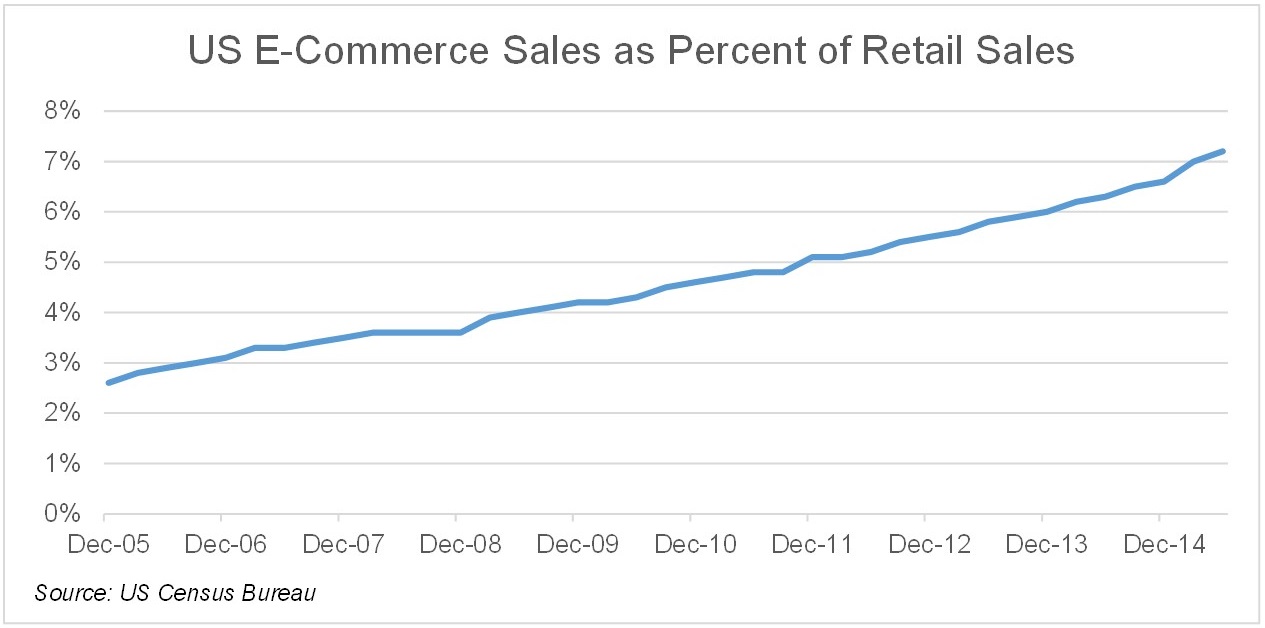
          The concept of selling through multiple and diverse channels is not a new concept, but the increased integration of in-store and e-tail channels is becoming more sophisticated. With 93% of consumer sales still occurring offline, many e-tailers understand that a physical presence can help escalate sales. Similarly, with this percentage shrinking and with $1.6 trillion in e-commerce sales expected this year, brick and mortar cannot ignore the importance of being online. Earlier this year, Square, in partnership with Bigcommerce, announced a new integration that provides merchants with a simple and seamless way to expand their businesses online. Similarly, Shopify’s POS system allows physical retailers to easily sell online.

          US retail sales

          E-Tailers Move to Physical Retail

          This post focuses on the trend of e-tailers moving into physical retail and when and why it can work. E-tailers fall into three categories: those that only sell other company’s brands, those that are creating their own brand, and those that sell other brands as well as their own.

          The dominant player in the first category is Amazon. ver time, it has built an overwhelming network of distribution centers geared towards efficiently shipping one or more items to an individual consumer. Now it has begun experimenting with physical locations, the first of which opened on the Purdue campus in February with additional locations being planned on other college campuses. There are also reports that it will follow this with other types of store openings. Given its widespread distribution centers, the company already has significant capability to inexpensively pick and pack goods for an individual consumer. But, despite limiting most shipments to one zone, there is still a relatively large cost to deliver a single order to an individual household. If it can begin getting non-Amazon Prime customers to come to a convenient location for pickup (Amazon locker or store), shipping cost could be reduced quite a bit. Further, having physical locations will undoubtedly add to the company’s sales and its brand. Since it would not need to stock the stores the way a traditional retailer does, it could capture the efficiency associated with centralized inventory locations combined with the brick-and-mortar efficiency of shipping a large number of goods to one location (probably in an Amazon-owned truck). I expect to see a major expansion of Amazon into physical locations over the next 5 years.

          Trading High Shipping Cost for Brick and Mortar Cost

          In e-commerce companies that we know well, fulfillment (picking and packing) and shipping can be as much as 40% or more of COGS.  Moving to one’s own physical retail stores adds substantial cost but removes shipping cost. Most e-tailers now offer some version of free shipping, but whether the seller or the customer pays for shipping, it is a major factor. What this means is that such an e-tailer can spend that money on its own stores or by offering to discount its products to a third-party brick and mortar reseller without necessarily incurring any loss in gross margin dollars (of course a larger discount may be required). Even if gross margins are lower when partnering with a third party brick and mortar retailer, it can still be as profitable as the e-tailer’s online sales since  brick and mortar stores already attract many customers whereas online sales normally require a marketing spend to create greater volume.

          The OmniChannel Approach for Branded Product

          Amazon is in a unique position because of its size. Although there are other e-tailers of third-party products with sufficient size to open their own physical locations, the bigger opportunity to increase sales resides with e-tailers that have their own branded product. A great example of this is Warby Parker, an emerging brand in eyewear. About 2 ½ years ago it opened its first brick and mortar store in New York City. What it found is that this not only added to its client base through in-store purchases, but also drove additional online sales. Why would this occur? Besides the obvious fact that many people still prefer buying from a physical location, trying on a pair of frames and having them fitted to your needs improves the experience. The inability to do this online may have inhibited some customers from purchasing. But once you have had the opportunity to have eyeglasses fitted to your requirements, it is much easier to buy subsequent pairs online with the knowledge that the fit should be appropriate.  The same issue of good fit applies to shoes and clothes.

          Fit is one reason why Bonobos, an online e-tailer of men’s clothes, began opening shops.  But unlike Warby Parker, the Bonobos shops are “Guideshops” (where clothing can be tried on and then ordered for delivery). By taking this approach, Bonobos keeps inventory centralized and the stores much smaller (only requiring one unit of each SKU) but gains the benefit of addressing people less comfortable with shopping online and also insuring that the clothes fit. By locating the shops in malls and other high traffic areas, Bonobos gains exposure to a fair amount of foot traffic making the stores another customer acquisition vehicle. Note that the stores we expect Amazon to open are essentially Guideshops but on a much larger scale.

          Online Brands Partnering with Brick and Mortar Retailers Will Continue to Increase

          Bonobos has also partnered with Nordstrom but in its case it’s simply as another brand offered in Nordstrom stores.  In August, Warby Parker announced their first retail partnership with Nordstrom. Once Nordstrom saw the benefits of OmniChannel brands, it acquired Trunk Club (another men’s clothing e-tailer). Subsequent to the acquisition, it began adding space in some of its stores for men to come in, get fitted and talk to a stylist about preferences. The stylist then acts as a personal shopper and picks Trunk Club clothes for the customer to try. This results in a much larger average order than online sales for Trunk Club. In this case the customer takes the clothes with him. Again, once this occurs, buying subsequent items online becomes easier as there is more confidence that the fit will be good. Now Trunk Club is entering the women’s clothing market to compete with the successful online brand, Stitchfix.

          Shoes are even more difficult to buy without trying on than eyeglasses or clothes. As a result, Shoes of Prey, which offers women the ability to design their own custom shoes, has also opened Guideshops but in their case they are in known retailers like Nordstrom. This makes sense to me as I prefer buying my first pair of shoes in a store and “refills” online. And now most brands that once were only available in brick and mortar stores can be purchased online. For the first pair I sometimes try on 8-10 styles/sizes before finding one that satisfies my needs (this is a major problem for Zappos who appears to have about a 35% return rate. If I try to buy a second pair a few months later from the same store, odds are they won’t have it. Instead, it’s seamless to go online for the follow-on pair. With the acquisition of Trunk Club, Nordstrom has taken a strong initiative in blending the online/offline experience.

          Notice the difference between Warby Parker and Bonobos versus Trunk Club. Warby Parker and Bonobos, in addition to being another brand at third party retailers, opened their own branded stores whereas Trunk Club began expanding into an existing major retailer (albeit its new parent) as a service to customers. Opening your own stores can involve substantial capital expenditures and large ongoing operating cost. The alternative of getting one’s online branded product to be carried by a retailer reduces risk and saves substantial fixed cost. But, there’s a trade-off; the brand gives up margin as the third-party retailer will be buying at a discount. Merely getting into stores does not guarantee added success. In the store, the control of the purchase experience moves to the retailer so it becomes very important that the brand is comfortable with the way the retailer will position its products in terms of shelf space and point of purchase marketing through materials and/or sales people in the store. Julep, a successful online brand in the cosmetics space, has partly solved the issue of positioning by partnering with QVC as well as several brick and mortar retailers including Nordstrom. A strong advantage of a QVC partnership is that “shelf space” allocated to the brand consists of a brand spokesperson going on the TV show to market the brand to a very large audience. Resulting sales occur immediately through QVC but other channels also benefit.

          Advantages to the Retailer of Carrying Online Brands in Their Physical Stores

          An online brand should have substantial information regarding customer demand. It knows the geographies in which its products sell best, the demographics of its customers, which of its products will be in greater demand, etc. It also may have very substantial traffic to its site, to which it can offer the alternative of buying at physical retail. Furthermore, unlike physical retail, e-commerce retailers have a deeper understanding of customer acquisition metrics and customer conversion funnel, and can readily A/B test various elements on their site. Such insights can help a physical store decide which items to carry, volumes needed in different geographies and more.  It can also mean the online brand will drive additional customers to their store. A brand like Le Tote, one of Azure’s portfolio companies, which offers women a subscription that entitles them to rent everyday clothes, has even more data as an average customer will have worn over 50 of their clothing items over the course of a year. Since the company receives ongoing feedback on most of the items it ships, it has very substantial data on customer preferences regarding third party brands as well as house brands. The company believes that it is likely to form one or more partnerships with brick and mortar retailers to begin selling its “house” brands.

          Intelligently Moving to OmniChannel Selling Makes Sense for Many Players

          Given the growing synergism between online and offline retail, there is substantial opportunity for heightened growth for startups that are able to intelligently emerge from an e-tail only model to one that uses both online and brick and mortar distribution. If the e-tailer has its own branded goods, then this can be done through partnering with existing stores. In executing this strategy, it is important to ensure that the presentation and knowledge of the products placed in such stores are sufficient to enable customers of the store to adequately learn about the products. In turn, the e-tailer can provide a deeper understanding of the customer in order to accelerate growth and improve sales conversions in all channels. The abundance of data being provided from online channels as well as in-store tracking can provide significant insight to retailers, and startups that best capitalize on this information are better positioned for success.  Startups that are able to capitalize on this trend can experience a significant escalation in growth.

          SoundBytes

          • The recent acquisition of EMC by Dell brought back memories of my thesis while still on Wall Street as a top analyst covering technology. In 1999 I predicted that successful PC companies would hit roadblocks to growth and profitability if they didn’t move “Beyond the Box”. As we’ve seen the prediction proved true as Apple thrived by doing so and others like Compaq, Dell, Gateway and HP ran into difficulty. I’m not as close to it now but the merger of these two companies seems to create obvious cross-selling opportunities and numerous efficiencies that should benefit the combined entity.

          Wal-Mart is making progress in ecommerce but it is less than people think

          Many years ago it became obvious to some of us that online retail would continue to grow at a much faster pace than brick and mortar stores. This appeared to be less obvious to traditional retailers until more recently. In 2001, I suggested to some colleagues that Wal-Mart should acquire Amazon to gain an edge in online retail (Amazon stock was about $5 a share at the time). This idea was scoffed at. I bought Amazon stock but, clearly, didn’t maximize my execution as I sold it within 18 months for 3 times the return (it’s now $317). I’m guessing there were also some prescient investment bankers who received a similar response after suggesting that Wal-Mart buy Amazon. Who knows what the world would be like today had that occurred, as Amazon could easily have been derailed under Wal-Mart management. Continue reading

          A Different Perspective on LinkedIn, The Dominant Business Social network

          A high proportion of people I know use Facebook as their social network and LinkedIn as their business network. LinkedIn has executed well in capturing a massive audience of business users with over 300 million members, especially in North America which has approximately one third of the network’s members (with Europe quickly catching up). Having done so, it is well positioned to replicate what Facebook has done on the social side – capture business discussions. The question is how can they best do this? LinkedIn’s Influencer Series identifies the most influential voices on LinkedIn and invites them to allow LinkedIn to distribute their articles. The distribution goes to the LinkedIn feeds of people who have opted into seeing posts from each writer. However, the relatively small number of posts and limited distribution doesn’t drive the user value and uptick in page views that could be possible if LinkedIn is to own business discussion in the way that Facebook owns social discussion. Earlier this year LinkedIn recognized this opportunity and opened its Influencer programs to its wider member base with hopes that it would generate more engagement. The move came shortly after the company disclosed that page views declined for the second consecutive quarter.

          Continue reading

          Will Satya’s manifesto make Microsoft a tech leader again?

          The CEO correctly lays out some of the ways the world is changing, but can the software maker really change? 

          Microsoft CEO Satya Nadella recently emailed Microsoft employees a speech that I’ll refer to as his “Satya Manifesto.” In it, he points out that the software maker must make fundamental strategic and cultural changes to deliver on his vision of being “the productivity and platform company for the mobile-first and cloud-first world.” He further states: “We will reinvent productivity to empower every person and every organization on the planet to do more and achieve more.”

          I was impressed with his willingness to shift Microsoft’s focus to the mainstream of where the world is moving. Yet, I couldn’t help compare his memo to a 1999 speech by Carly Fiorina after assuming the CEO role at Hewlett Packard. In her speech she said, “…we are a single global ecosystem – wired, connected, overlapping …”

          Continue reading

          How Microsoft can disrupt the tech industry again

          By rethinking its acquisition strategy, the computer software and electronics company can be an innovator in growing sectors, such as cloud services, smart phones and teleconferencing

          Microsoft’s stock has been stagnant as investors lose faith in the company’s plans for its future. After peaking at just under $60 a share in early 2000, Microsoft’s stock fell to about $22 later that year and has traded mostly between $25 and $40 a share in the 14 years since then. While revenue and earnings per share have more than tripled since then, the stock price has not followed suit. The question of why can be answered fairly simply: investors have lost faith in Microsoft’s future ability to control its core markets.  What Microsoft could do can be answered fairly simply: Take a page out of Facebook’s apparent strategy and buy best of breed next generation companies. Continue reading